

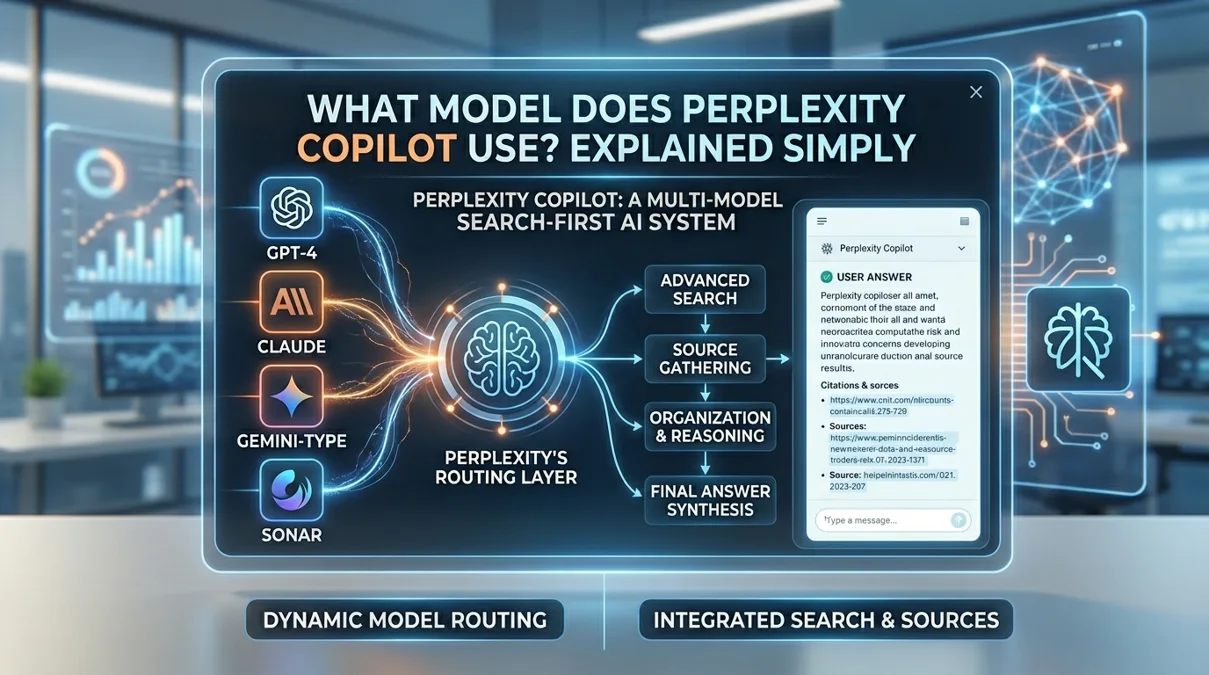
Quick answer: Perplexity offers multiple models; GPT-4, Claude-2, and PaLM-2 should not be treated as a fixed list of its current options. Check the model selector for your plan and mode. Perplexity maintains an official model availability guide, and its model-selection instructions explain where to choose. Having several model options does not mean every search runs all of them at once.
Updated October 9, 2026. The query “Perplexity AI Copilot underlying model GPT-4, Claude-2, PaLM-2” uses older product and model names. It should not be read as proof that those three models are the current backend, or that all three run together.
The useful distinction is between an underlying language model, the search mode, and the subscription that controls access.
Perplexity combines search and source retrieval with its own and third-party language models. You interact with the whole search product, not a model in isolation.
Instead, it works more like a search-driven AI platform that can switch between models, gather real-time information, and then generate a final answer using its own system.
This guide explains those layers and shows what to check in your account before comparing answer quality.
Here’s the simple truth:
Several models can be offered by one service without every answer being generated by every model. Automatic selection and deliberate multi-model consultation are different features.
Start With the Search Task
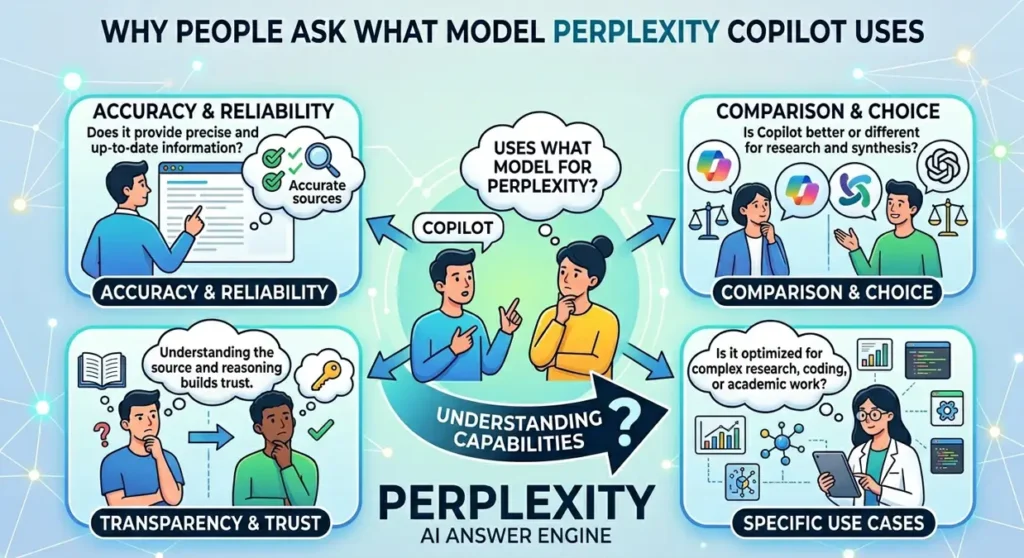
Start with the job you need done: finding a current fact, comparing sources, understanding a document, or producing a longer research report.
That is why checking the source and its date can matter more than choosing the most expensive model.
Perplexity does not just generate text. It also searches, pulls sources, organizes information, and turns that material into a direct answer. So when someone asks what model Perplexity Copilot uses, they are really asking two things at once: what powers the reasoning, and what makes the product feel different from a normal chatbot.
That is why this topic keeps coming up. The question sounds simple, but the product behind it is not as simple as it used to be.
One Model, Automatic Selection, or Model Council?
Perplexity’s current model-availability guide distinguishes Search, automatic Deep Research, and Model Council. The selector in your account is the practical authority for available Search models.
In Search, “Best” means automatic model selection; it is not the name of a separate language model.
Quick Comparison: Perplexity AI Copilot underlying model GPT-4 Claude-2 PaLM-2 vs multi-model system
| Feature | Single Model (GPT-4 / Claude-2 / PaLM-2) | Perplexity Copilot |
|---|---|---|
| Model Type | One fixed model | Multi-Model System |
| Search Capability | Limited / External | Real-time built-in search |
| Sources & Citations | Rare or manual | Automatic with references |
| Flexibility | Same model for all tasks | Switches models based on task |
| Answer Style | Only AI-generated | Search + AI combined answers |
| Best For | Chat & reasoning | Research & accurate answers |
The Free plan does not provide manual advanced-model selection. Paid-plan access is subject to usage limits and the available options shown in your account.
Enterprise organization settings, plan differences, staged releases, and regional availability can affect the list. An option shown in another person’s screenshot may not be available to you.
That means the old-style answer — treating Perplexity as one permanent model — is too narrow.
Model Council explicitly consults multiple models and has its own plan and web-availability requirements. Do not generalize that behavior to every ordinary search.
How Model Choice Fits the Search Workflow
GPT, Claude, Gemini, and Sonar are model families or options within the service. Their exact versions change; use the official availability guide and account selector rather than an old article’s list.
To compare models, use the same question, mode, source scope, and requested output. Note the model selected and save the citations. Judge factual support, completeness, and useful reasoning before judging writing style.
That is why Perplexity feels different from opening a plain chat interface on a single model. The model may help with the reasoning, but Perplexity still handles the searching, source gathering, organization, and final presentation.
The key distinction is between the language model and the search product:
The language model produces or helps synthesize the answer; the product also determines search behavior, available tools, source presentation, and account limits.
Historical GPT-4, Claude-2 and PaLM-2 Queries
Older answers to this question usually came from an older way of comparing AI products.
An old query can remain popular after product names and model versions have changed. Keep that historical wording separate from current availability.
Do not assume PaLM-2 is currently offered simply because it appears in the query. This guide does not establish that every model named in the historical search phrase was actually used by Perplexity.
When reading an older explanation, check its publication date, the model version, the plan described, and whether the author links to a contemporaneous official announcement.
For present-day use, consult the account interface and current help documentation. This avoids turning an old model-name association into an unsupported current claim.
How to Check Sources and Compare Answers
For users, the underlying model still matters.
A practical source check: open each citation that supports a key statement, confirm that the page says what the answer claims, and check whether it applies to the relevant date, country, version, or plan.
For a comparison question, ask the system to separate verified facts from inferences and identify where sources disagree. If a citation does not support the sentence, treat that sentence as unverified.
Illustrative prompt: “Compare these two tools for my stated task. Use official documentation, list the date and plan for each limitation, and flag facts you cannot confirm.” This is a prompt example, not a measured test result.
That is where Perplexity’s own layer matters just as much as the model itself. The answer quality comes from the mix of model capability and Perplexity’s search-and-answer workflow.
What Model Choice Cannot Guarantee
Having citations does not make every answer correct. Sources can be incomplete, stale, or misinterpreted, and the generated summary can still contain errors.
Changing the model may improve an explanation but cannot guarantee correct retrieval, complete coverage, or faithful citation. Verify consequential facts directly in the underlying source.
Do not compare a plain chat answer with a research report as though the model were the only difference. Search mode, source scope, tools, and allowed time also affect the result.
Do not upload private documents until you have checked the service’s data-use and retention terms and any workplace policy that applies. A paid subscription is not by itself proof of suitable privacy controls.
If the Model or Answer You Need Is Missing
Here is the plain-English answer.
If you cannot see a model option, first check your active account, subscription, selected mode, and organization restrictions. Do not assume the missing option is a browser fault.
Before contacting support, record the visible mode and model choices and consult the official availability guide. Avoid sharing confidential prompts or account secrets in a support screenshot.
If the answer remains weak, narrow the question, specify the version and date, and request primary sources. Switch model or mode only after identifying whether the problem is retrieval, reasoning, or insufficient context.
The practical answer: Perplexity supports different models through a search-and-answer product. The historical GPT-4, Claude-2, PaLM-2 phrase is not a reliable description of its current model lineup.
Compare Grok vs ChatGPT for coding, writing and real-time answers.
Explore the best LLMs for coding to compare models for development tasks.
FAQs
Does Perplexity still use GPT models?
GPT-family options can be available, but the exact version and access depend on your account, plan, and mode. Check the current selector rather than assuming GPT-4 is still offered.
Does Perplexity use Claude models too?
Claude-family options can be available. Versions and plan access change, so consult your selector and the official model-availability guide.
Is Perplexity powered by one model only?
Perplexity is a service that can offer several models. An ordinary search does not necessarily consult all of them; automatic selection and Model Council are separate behaviors.
What is Sonar in Perplexity?
Sonar is Perplexity’s model family for search-related use. Check the currently listed version rather than assuming older Sonar names describe the current service.
What is the short answer to what model Perplexity Copilot uses?
The historical search phrase is not a reliable current model list. Check your plan and mode, then verify the selected model and the citations supporting the answer.
