


Construction has always been one of the hardest industries to automate. You’ve got unpredictable job sites, heavy machines, complex safety rules, and tasks that seem impossible to hand off to a robot. For years, people said it couldn’t be done.
Then 2025 happened.
In a single year, venture capital poured over $1.36 billion into construction robotics startups — a 125% jump from all of 2024. And in early 2026, that pace didn’t slow down. It accelerated. A single company, Bedrock robotics construction news, raised $270 million in February alone. FieldAI had already secured $405 million the summer before. Caterpillar showed up at CES 2026 with a lineup of autonomous excavators, bulldozers, and trucks backed by 30 years of research.
This is no longer a “future of construction” story. Robots are on job sites right now — tying rebar, laying bricks, scanning structures, and operating excavators without a human in the cab.
This article breaks down everything happening in Construction Robotics News right now: the biggest news, the companies leading the charge, how the technology actually works on real sites, what the challenges still are, and where things are headed in the next 12 months.
Why Construction Robotics Is Gaining Attention
For most of the last decade, construction sat near the bottom of every automation ranking. Agriculture automated. Manufacturing automated. Warehouses automated. Construction — with its chaotic outdoor sites, one-off project designs, and fragmented industry structure — stayed manual.
That started changing around 2022, and by 2026 it has reached a genuine inflection point. Here is why investors, contractors, and technology companies are all paying attention at the same time.
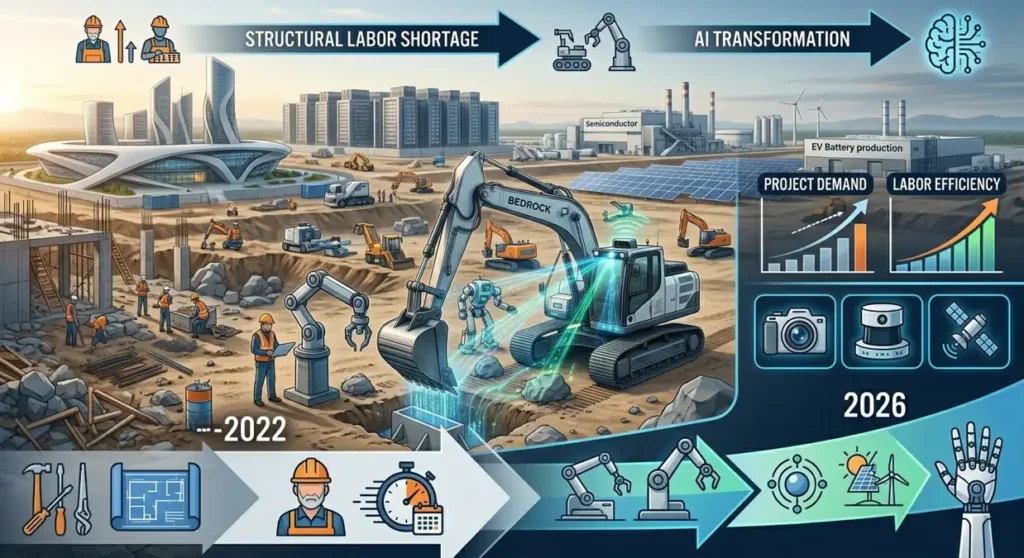
The labor shortage is not a temporary problem. The construction industry in the United States needs nearly 800,000 additional workers over the next two years just to keep up with project demand, according to industry estimates. Project backlogs climbed to more than eight months as of late 2025. An aging workforce and a shrinking pipeline of new tradespeople means this gap is structural, not cyclical. Robots are no longer a productivity upgrade — they are becoming a basic operating necessity.
AI has changed what robots can do. The big shift is not hardware, it is intelligence. Earlier construction robots could follow preprogrammed paths. They broke down when conditions changed. Modern robots equipped with AI — specifically physical AI systems that use lidar, cameras, GPS, and machine learning — can perceive their environment, adapt to obstacles, and make real-time decisions. An AI-equipped excavator today does not just follow a digital surface model. It reasons about terrain, coordinates with other machines, and adjusts when something unexpected happens. That is a fundamentally different capability.
The infrastructure build cycle is creating massive demand. Data centers, semiconductor factories, solar farms, and EV battery plants all require enormous amounts of construction, fast. The companies driving these projects are not willing to wait on traditional timelines. They are actively seeking construction partners who can use technology to compress schedules. That demand is pulling robotics adoption faster than any technology push could.
Capital has validated the sector. When Google’s growth fund CapitalG and NVIDIA’s venture arm NVentures both write checks into the same Construction Robotics News startup in the same round, it sends a message to every other investor. That is exactly what happened with Bedrock Robotics in February 2026. Strategic investors — including construction firms themselves — are writing checks, which compresses the gap between investment and actual deployment.
The result is a sector that has gone from interesting research projects to real deployed tools on real job sites, with real ROI data, in a shorter time than most people expected.
Latest Construction Robotics News and Updates
Here are the most significant developments in robotics construction news from 2025 through early 2026, organized as they actually happened.
Bedrock Robotics Raises $270 Million — February 4, 2026
The single biggest Construction Robotics News story of early 2026. Bedrock Robotics, a San Francisco-based startup founded by former Waymo engineers, closed a $270 million Series B round co-led by CapitalG (Google’s independent growth fund) and the Valor Atreides AI Fund. NVIDIA’s venture arm NVentures, 8VC, Eclipse, Emergence Capital, Tishman Speyer, and MIT all participated.
The round brings Bedrock’s total funding to over $350 million at a valuation of $1.75 billion — a company that did not exist publicly until July 2025, when it emerged from stealth with $80 million already in the bank.
Bedrock’s product, the Bedrock Operator, retrofits existing heavy construction equipment — excavators, bulldozers, loaders — with a package of lidar sensors, GPS, and motion systems that enables fully autonomous operation. It installs in a few hours with no permanent modifications to the machine. The company completed a large-scale deployment on a 130-acre manufacturing site in Arizona in partnership with Sundt Construction, running supervised autonomous excavation for mass earthmoving.
CEO Boris Sofman framed the problem clearly: the construction industry is being asked to build more than it can deliver. Bedrock’s pitch is that contractors can use the same machines they already own, just operated autonomously.
FieldAI Raises $405 Million — August 2025
Before Bedrock, FieldAI set the tone for the entire sector. The company, which builds an AI software platform described as a “brain” for construction site robotics, raised $405 million in a massive round that signaled investor conviction in the intelligence layer of construction automation — not just the hardware.
FieldAI’s approach is to make different types of robots and equipment work together on a job site through shared AI coordination. Think of it as the operating system that sits above individual robots and lets them function as a fleet.
Caterpillar at CES 2026 — January 2026
At CES 2026, Caterpillar, the 100-year-old heavy equipment company, unveiled a new generation of autonomous construction machines. The announcement was notable not for being surprising but for what it confirmed: the largest incumbent in the industry is fully committed to autonomous operation. Caterpillar’s Chief Technology Officer Jaime Mineart said the systems are backed by over three decades of automation research and real-world deployment in mining and construction.
Sitegeist Robotics Raises €4 Million — February 2026
Munich-based Sitegeist, a spin-out from Technical University Munich, raised €4 million in pre-seed funding to commercialize robots designed for concrete renovation work. The company’s machines handle the physically demanding job of removing deteriorated concrete from aging bridges, tunnels, and parking structures — up to 10 times faster than human workers.
This one matters because it represents a different end of the market: smaller, specialized robots solving specific problems (like Europe’s enormous infrastructure repair backlog) rather than total site automation.
$208 Million Across Six Companies — July 2025
In a single month in summer 2025, six construction technology companies raised a combined $208 million in capital — one of the highest-density months for construction tech investment on record. This was not one big deal. It was a broad wave showing that investor appetite extended well beyond a few headline companies.
| Company | Category | Primary Application | Capital Raised | Status |
|---|---|---|---|---|
Bedrock RoboticsSan Francisco, USA · Est. 2024 |
Autonomous Equipment | Retrofit kits that enable excavators and bulldozers to operate driverless on active sites | $350M+ | Scaling |
FieldAIUSA · Est. 2022 |
AI Fleet OS | Unified intelligence layer that orchestrates diverse robot fleets across a single job site | $405M | Scaling |
Built RoboticsSan Francisco, USA · Est. 2016 |
Autonomous Equipment | Self-driving dozers and solar pile-driving systems for heavy earthworks | $137M | Growth |
Dusty RoboticsMountain View, USA · Est. 2018 |
Layout Automation | Prints BIM-generated floor markings directly — replaces manual tape-and-chalk layouts entirely | ~$105M | Scaling |
Advanced Construction RoboticsPittsburgh, USA · Est. 2017 |
Civil / Rebar | TyBOT autonomously ties rebar on bridge decks and large poured-concrete slabs | Undisclosed | Scaling |
ICONAustin, USA · Est. 2017 |
3D Concrete Printing | Extrudes structural walls layer by layer — already deployed across entire housing communities | $451M+ | Scaling |
Boston Dynamics — SpotWaltham, USA · Est. 1992 |
Inspection Robotics | Walks live construction sites capturing photos, point clouds, and progress data hands-free | Hyundai-backed | Scaling |
Sitegeist RoboticsMunich, Germany · Est. 2023 |
Demolition / Renovation | Robotic concrete removal system operating up to 10× faster than conventional manual crews | €4M | Early Stage |
Fastbrick Robotics (FBR)Perth, Australia · Est. 1994 |
Robotic Bricklaying | Hadrian X reads digital blueprints and lays bricks fully automatically from foundation to roof | ASX-listed | Growth |
CaterpillarIrving, USA · Est. 1925 |
Autonomous Equipment | Full lineup of autonomous excavators, dozers, and haul trucks unveiled at CES 2026 | NYSE: CAT | Scaling |
Construction Robotics News in 2026 is not one technology. It is a collection of systems, each solving a specific problem. Here is a breakdown of the main categories and the companies leading each one.
Autonomous Heavy Equipment
This is where the biggest money is going right now. The core idea is retrofitting or redesigning excavators, bulldozers, and loaders to operate without a human operator — or with minimal supervision.
Bedrock Construction Robotics News is the most funded example: their Operator kit mounts to existing machines and enables full autonomous excavation. Built Robotics ($137M raised total) has been automating dozers and now focuses heavily on solar farm construction, where piling work involves highly repetitive, GPS-guided tasks that are ideal for autonomy. Caterpillar is doing this at scale in mining and is expanding into construction. Komatsu has had semi-autonomous earthmoving equipment commercially available for several years and is deepening the AI layer.
The economics make sense in specific contexts: large, open sites with repetitive work (solar farms, data center campgrounds, road grading) where a robot can run 24 hours and the task does not require human judgment. Urban construction with tight spaces and complex underground utilities is harder and will take longer.
Robotic Bricklaying and Masonry
Construction Robotics’ SAM (Semi-Automated Mason) system has been commercially deployed on multiple projects in the United States. SAM works alongside a human mason: the human handles corners, complex cuts, and placement decisions, while SAM handles the repetitive laying of standard courses. The result is roughly 3 to 5 times more bricks laid per shift compared to a traditional two-person crew.
Fastbrick Robotics (FBR) from Australia has developed the Hadrian X, a truck-mounted fully automated bricklaying system that builds walls directly from a digital model. Monumental in the Netherlands is taking a different angle with its Atrium software, which creates digital twins of the build and coordinates multiple robots for bricklaying with real-time quality control.
Buildroid AI is preparing for first US deployments in 2026, using Nvidia Omniverse-powered digital simulations to optimize multi-robot bricklaying workflows before any hardware arrives on site.
Layout Robots
One of the quieter success stories in construction robotics is automated layout — robots that mark exact measurement points on concrete floors based on digital blueprints.
Dusty Construction Robotics News has the most widely deployed system in North America: an autonomous mobile robot that rolls across a slab and marks the layout for all trades (framing, MEP, structural) with centimeter accuracy. The ROI calculation is straightforward — layout takes time, requires skilled labor, and errors ripple through the entire project. Automating it is a clear win with a fast payback.
Civ Robotics does the same for outdoor civil work — marking coordinates for excavation, grading, and utility installation on large sites.
Reality Capture and Inspection
Boston Dynamics’ Spot robot is the most recognized name in construction inspection. Equipped with cameras, lidar, and 360-degree scanning tools, Spot navigates job sites autonomously and captures detailed progress data that feeds into BIM systems. The main use case is tracking construction progress against the digital model, catching deviations before they become expensive.
Several other companies — including NavVis and Matterport — offer mobile scanning platforms that either operate autonomously or are carried through a site to create digital records. These tools are already in widespread use on large commercial projects.
Rebar Tying Robots
Advanced Robotics Construction News’ TyBOT is probably the most proven heavy-duty construction robot in commercial deployment today. TyBOT operates on bridge decks and other large rebar mats, automatically tying rebar intersections — a task that is highly repetitive, physically punishing for human workers, and perfectly suited for a robot. On large bridge projects, TyBOT has reduced the crew needed for rebar tying and significantly cut the time on that phase.
IronBOT, also from Advanced Construction Robotics News, handles the heavy material — picking up and placing rebar — while TyBOT ties it. The two work together as a system.
3D Concrete Printing
ICON in Texas is the furthest along in printed construction for residential applications. COBOD in Denmark operates large gantry printers for commercial and infrastructure applications. Apis Cor has received strategic investment from major homebuilders including D.R. Horton.
The economics of 3D printing work best in specific conditions: remote locations, housing markets with severe affordability problems, and applications where the design complexity or material reduction justifies the setup cost.
Real-World Use Cases in Building and Infrastructure
Research reports are one thing. Here is what construction robots are actually doing on real sites right now.
Bridge Construction — Rebar Tying at Scale. On the Koppel Bridge project in Pennsylvania, TyBOT handled the rebar tying for large sections of the bridge deck. The result was a significant reduction in the size of the rebar crew and faster completion of the tying phase. On a large bridge, a mat of rebar can have hundreds of thousands of intersections — each one needs to be tied. A human crew can tie several hundred per hour. TyBOT works continuously.
Solar Farm Construction — Autonomous Piling. Built Construction Robotics News has deployed autonomous systems on solar construction sites where pile installation is GPS-guided, highly repetitive, and covers hundreds of acres. The results consistently show 25 to 40 percent faster installation rates compared to manual crews, with pile positioning accuracy within half an inch compared to the 2 to 3 inch variance typical of manual work.
Large-Scale Earthmoving — Bedrock + Sundt. In their first major commercial deployment, Bedrock Robotics worked with Sundt Construction on a 130-acre manufacturing facility site, automating excavators for mass excavation under supervised autonomy. The operator monitored the work remotely while the machines executed the dig plan. This kind of deployment — one supervisor overseeing multiple autonomous machines — is the economic model that makes autonomous equipment viable.
Residential Construction — 3D Printed Homes. ICON has printed entire streets of homes in Texas and has projects underway for affordable housing applications. The company’s Vulcan printer works with concrete to build the structural walls of a home. Framing, roofing, and finish work still require traditional labor, but the printed shell is faster and potentially more material-efficient.
Infrastructure Inspection — Boston Dynamics Spot on Sites. Major general contractors including Turner Construction and Skanska have deployed Spot on large commercial projects for progress documentation. The robot walks the site on a programmed route, captures data, and the system generates automated progress reports. What used to take a day of manual photography and documentation now happens in a fraction of the time with richer data.
Concrete Renovation — Sitegeist in Europe. The company’s AI-powered robots are working with German concrete renovation firms on bridges, tunnels, and parking structures, removing deteriorated concrete at ten times the speed of human workers. The labor shortage in physically demanding renovation work is severe in Germany and across Europe — this is exactly the kind of problem that makes robotic deployment economically straightforward.
Benefits of Robotics in Construction Projects
The case for construction robotics in 2026 is not theoretical. It is based on data from real deployments.
Labor savings that actually show up in project budgets. Across layout robots, rebar tying systems, and autonomous earthmoving, the documented labor savings range from 30 to 50 percent on the specific tasks the robot handles. That does not mean you cut the crew in half — it means the crew gets more done, or you need fewer people for a specific phase, or you can maintain schedule when you cannot hire enough workers.
Accuracy and rework reduction. Human error in layout — a measurement slightly off, a point marked in the wrong place — costs money later when framing is off or MEP systems do not fit. Automated layout systems operating from digital models directly eliminate this class of error. Rework rates on piling and layout work drop significantly when robots handle the execution.
Safety on dangerous tasks. Concrete demolition, rebar tying on large mats, operating heavy equipment in confined spaces — these tasks carry real injury risk. Removing humans from the most hazardous work is not just a productivity argument. It is a liability, insurance, and human cost argument. The construction industry has one of the highest occupational injury rates of any sector.
24-hour operation on the right tasks. An autonomous excavator or piling rig can run overnight when conditions allow. On a large earthmoving project or a solar farm, this can compress the schedule meaningfully.
Data and documentation. Inspection and scanning robots generate detailed records of construction progress against the digital model. This has downstream value for quality control, dispute resolution, and facility management after handover.
Challenges Facing Construction Robotics News Adoption
The money is real. The technology works on specific tasks. But Construction Robotics News still faces genuine obstacles that explain why adoption has been slower than enthusiasts predicted, and why it will not reach full penetration quickly.
The job site variability problem. A warehouse or factory floor is consistent. A construction site changes every day — new obstacles, different terrain conditions, changing crew configurations, weather. Robots that work well in structured environments struggle when conditions shift. The gap between “works in a pilot” and “works reliably across all site conditions” is significant. Companies like Bedrock are specifically building systems designed to handle this variability, but it remains the core technical challenge.
High upfront costs for smaller contractors. A bricklaying robot, an autonomous layout system, an inspection robot — these are meaningful capital investments that are hard to justify on smaller projects. The economics work for large commercial or infrastructure projects. They are harder for residential builders or smaller general contractors. The Robot-as-a-Service subscription model (paying per use rather than buying) is emerging as a solution, but it is still early.
Regulatory and liability gaps. When an autonomous excavator makes a decision that causes damage or injury, who is responsible? The regulatory frameworks for autonomous construction equipment are still being written. Some jurisdictions require a licensed operator to be present even for supervised autonomous operation. These questions are not insurmountable, but they add friction to adoption.
Workforce resistance and training gaps. Construction crews have legitimate concerns about automation. The industry’s response to this — so far — has generally been “robots do the worst jobs, humans do the skilled work” which is mostly true in practice, Operators need to learn to supervise autonomous systems, which is a different skill set from operating equipment directly.
Integration with existing workflows. Most robots require high-quality digital data — BIM models, precise site surveys, GPS networks — to function. Many construction companies, particularly smaller ones, do not have mature digital workflows. Deploying a robot often requires upgrading the surrounding processes first, which adds complexity and cost beyond the robot itself.
Future Outlook for Robotics Construction News
The next 12 months will likely be defined by a few specific developments that are already in motion.
Fleet coordination becomes the real product. The next step beyond a single autonomous machine is multiple machines working together. Bedrock’s stated goal is not just one autonomous excavator — it is coordinated fleets where excavators, trucks, and graders operate as a connected system with one supervisor. FieldAI’s entire model is built around this fleet intelligence layer. When fleet coordination becomes reliable, the economics of autonomous construction shift dramatically.
Physical AI comes to the edge. At CES 2026, NVIDIA introduced tools for deploying physical AI models directly on the robot hardware rather than relying on cloud connectivity. This means robots can reason and adapt locally, in real time, without sending data back to a server. For construction sites with poor connectivity and fast-changing conditions, edge AI is what makes reliable autonomous operation practical.
Interior and MEP work becomes the next frontier. The robots that have proven themselves commercially — layout printers, rebar robots, earthmoving autonomy — all operate in relatively open, structured environments. The harder problem is interior construction: drywall finishing, MEP installation, ceiling work in complex building spaces. Several companies are working on these problems. Investor data suggests this category is at earlier stage and higher risk, but the commercial opportunity is large.
Robot-as-a-Service compresses the adoption timeline. As more companies offer subscription or per-project pricing for construction robots, the barrier for smaller contractors drops. You do not need to buy a $300,000 autonomous system — you hire it for the phase of the project where it makes sense. This model is already appearing for layout robots and inspection systems, and will expand.
Watch for consolidation. With this much capital in the sector and a relatively small number of construction companies as customers, some form of consolidation is likely. Larger equipment companies (Caterpillar, Komatsu, Hilti) are watching the startup space carefully. Strategic acquisitions — similar to how Pronto acquired SafeAI in the off-road autonomy space — will reshape the competitive landscape.
Construction Robotics: Key Milestones 2025–2026
TIMELINE Total tracked funding: $1.7B+Frequently Asked Questions
What is construction robotics?
Construction robotics refers to automated machines and systems designed to perform tasks on construction sites — everything from autonomous excavators and bricklaying robots to inspection drones and 3D concrete printers. These systems use a combination of hardware (sensors, actuators, GPS) and AI software to operate with varying degrees of autonomy, either replacing human labor on specific tasks or working alongside human crews to improve speed and accuracy.
Why is construction robotics getting so much investment in 2026?
Three forces are driving investment at the same time. First, a structural labor shortage in construction that cannot be solved by hiring alone. Second, AI advances that have made robots genuinely capable of handling the variability of real job sites. Third, a massive infrastructure build cycle — data centers, semiconductor plants, solar farms, energy projects — creating urgent demand for faster construction. Investors see a large market with a real problem and technology that is ready to deploy at scale.
Which construction robotics technologies are the most proven right now?
The categories with the strongest commercial track records are layout automation (Dusty Robotics), rebar tying (TyBOT by Advanced Construction Robotics), autonomous earthmoving on solar and large civil sites (Built Robotics, Bedrock Robotics), inspection and reality capture (Boston Dynamics Spot, various mobile scanning platforms), and 3D concrete printing for residential applications (ICON). These have moved beyond pilots into repeat commercial use.
What is Bedrock Robotics and why does it matter?
Bedrock Robotics is a San Francisco startup founded by former Waymo autonomous vehicle engineers that raised $270 million in February 2026 at a $1.75 billion valuation. Their product retrofits existing heavy equipment — excavators, bulldozers — with autonomous operation capability. The significance is twofold: the scale of the funding validates investor confidence in construction autonomy, and the ex-Waymo team brings self-driving vehicle expertise directly into construction equipment, which has historically lagged the automotive world on autonomy.
Will construction robots replace construction workers?
The honest answer is: on specific tasks, yes — eventually. On complex, judgment-intensive work, no, not in any near-term timeframe. The pattern in every industry that has automated is that robots take over the most repetitive, physically demanding, or hazardous tasks, while human workers shift toward supervisory, skilled craft, and problem-solving roles. In construction specifically, the labor shortage is so severe that most industry analysts expect robots to fill gaps rather than displace workers who would otherwise have jobs. The bigger near-term impact is that a smaller crew can accomplish more, rather than large-scale workforce reduction.
