

Updated October 9, 2026. The best AI voice agent for small business is the one that completes your real calls safely and fits your budget. Goodcall is a candidate for local US answering and booking; Retell and Vapi suit configurable voice workflows; Bland supports inbound and outbound operations. Synthflow’s current enterprise pricing may put it beyond a small team’s budget. Test integrations, human handoff, and total cost before launching.
This is a documentation-based buyer guide, not a hands-on ranking of all five platforms. The shortlist covers call handling, integration effort, costs, and safeguards; no universal fastest or most natural voice is claimed.
Start with one call type, such as after-hours intake or appointment rescheduling. Prove that the agent can complete that workflow without double bookings, invented policies, or failed transfers before expanding it.
Quick Buyer Snapshot
What small businesses should know before choosing a voice AI tool
The best AI voice agent for small business is not always the most advanced one. In most cases, the right choice is the tool that fits your call volume, handles bookings or support smoothly, and is easy enough for your team to manage without constant technical help.
Best fit for this guide: clinics, salons, home-service businesses, local offices, and small teams that want real phone automation instead of another complicated software layer.
What Is an AI Voice Agent?
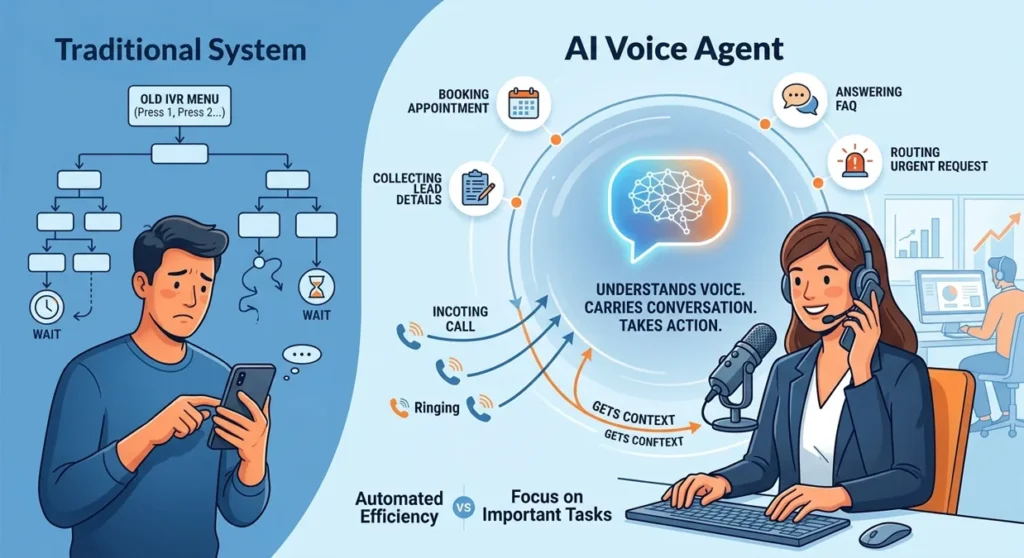
An AI voice agent is a phone-based assistant that can answer calls, speak naturally, understand what the caller wants, and take action during the conversation. That action might be booking an appointment, collecting lead details, routing an urgent request, answering a common question, or passing the call to a staff member with the right context.
A traditional phone tree just tells people to press numbers. A modern voice agent actually carries the conversation forward. If it is built well, it feels less like a machine and more like a competent front-desk assistant who can handle repetitive tasks all day without getting distracted.
Give the agent a limited role and a clear escalation path. It should identify itself appropriately, handle only approved tasks, and involve staff when it is uncertain. Do not rely on it for emergencies or clinical decisions.
Why Small Businesses Need AI Voice Agents
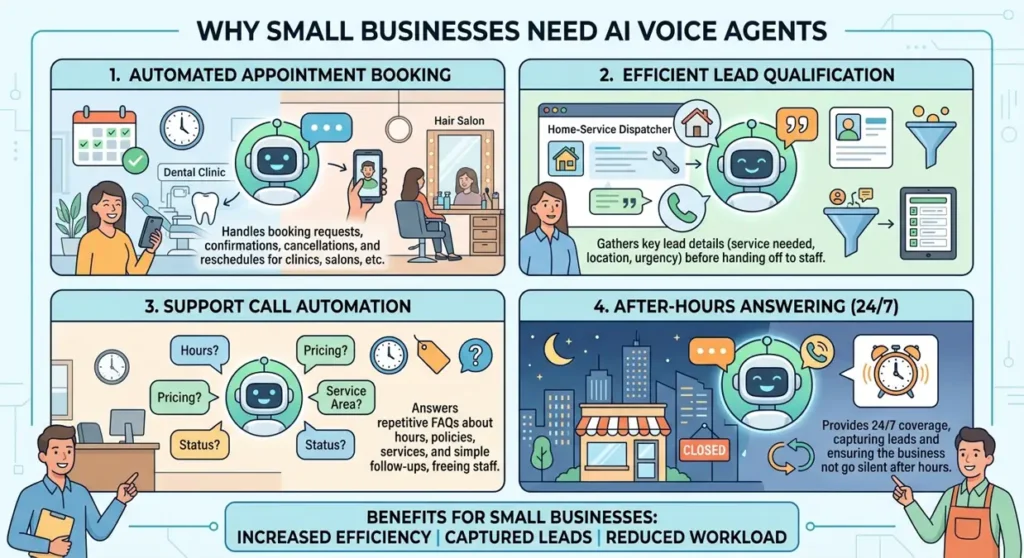
Small businesses usually deal with the same problem in different forms: too many repetitive calls and not enough people to answer them properly. A dental clinic gets appointment requests and rescheduling calls. A salon gets booking questions. A home-service company gets quote requests, emergency calls, and people asking if someone can come out today.
This is where choosing the best AI voice agent for a small business starts making sense. It gives small teams coverage without forcing them to hire another full-time receptionist or lose after-hours leads. And unlike voicemail, it actually keeps the conversation moving.
Appointment booking
Appointment automation helps only if the calendar integration checks availability, time zones, service duration, and rescheduling rules. Test concurrent booking requests and confirmation delivery; a convincing conversation is not evidence that the booking was actually saved.
Lead qualification
Not every caller needs a full sales conversation on the first attempt. Sometimes the business just needs the basics: what service they need, where they are located, how urgent the issue is, and whether they are ready to move forward. Voice AI can gather that information and hand the lead off in a cleaner format.
Support calls
Many support calls are repetitive. Store hours, pricing basics, service areas, booking status, policy questions, refill requests, and simple follow-ups can often be handled without involving staff every single time.
After-hours answering
This is where a lot of businesses lose money without realizing it. A missed call at 8 p.m. may not feel urgent in the moment, but if the caller reaches a competitor who answers, that opportunity is gone. A voice agent does not replace your team after hours. It simply makes sure the business does not go silent.
Best AI Voice Agents for Small Business in 2026
| Candidate | Evaluate for | Key limitation or check |
|---|---|---|
| Goodcall | Local US answering, intake and booking | US numbers; specific integrations; BAA and plan required for PHI |
| Synthflow | Enterprise voice workflow deployment | Current enterprise contracts start at $30,000 annually |
| Retell AI | Configurable phone-agent workflows | Verify integrations, full cost and healthcare agreement scope |
| Vapi | Custom voice-agent implementation | Hosting plus model, voice, transcription and carrier costs |
| Bland AI | Inbound and outbound call operations | Plan-specific concurrency, carrier setup and consent requirements |
There is no single answer to the question of the best AI voice agent for small business. The right choice depends on whether you want easy deployment, deeper customization, stronger healthcare support, or better outbound calling. Still, a few platforms stand out more than the rest.
Goodcall
Goodcall’s current FAQ describes local US phone numbers, call forwarding, Google Calendar booking, and escalation contacts. GC4 integrations differ from the older GC3 Zapier workflow. Check your exact calendar or CRM and country support before choosing it. Its US-number limitation matters for businesses outside the United States.
Synthflow
Synthflow’s current pricing page is enterprise-focused and lists contracts starting at $30,000 annually. The final scope depends on call volume, concurrency, telephony, integrations, security, and launch support. Small teams should obtain a relevant quote before treating it as an affordable no-code starting point.
Retell AI
Retell is a candidate for configurable voice workflows and healthcare-related deployments. A vendor’s healthcare page is not evidence that your particular configuration meets requirements: confirm the required BAA, data handling, integrations, and escalation arrangements before using patient information.
Vapi
Vapi provides a platform for building voice agents. Its usage-only billing separates hosting from model, voice, transcription, and telephony costs. Technical setup and ongoing monitoring can be part of the expense; evaluate the complete pipeline rather than a single per-minute headline.
Bland AI
Bland supports inbound and outbound phone agents. Check the exact plan’s concurrency, phone numbers, carrier costs, routing, integration, and deployment terms. Outbound capability is not permission to run an unsolicited calling campaign.
Use the shortlist as a set of candidates: Goodcall for supported local US reception workflows, Retell or Vapi for configurable implementations, Bland for call operations, and Synthflow when its enterprise contract fits the project. These are use-case starting points, not independent quality ratings.
Shortlist by implementation need: begin with a reception-focused service when you need limited setup; compare configurable platforms when you need custom business actions; consider enterprise implementation only when the contract and operational budget fit. For clinics, check the whole patient-data workflow and agreements before ranking a vendor by voice quality.
Features to Look for in the Best AI Voice Agent for Small Business
Most buyers get distracted by demo quality. A voice demo can sound great and still fail in real use.
Natural conversation
The voice should sound clear and calm, but that is only part of it. The real test is whether the agent can handle interruptions, understand common phrasing, and keep the call moving without sounding stiff or confused.
Action during the call
A voice agent should do more than talk. It should be able to book, transfer, collect information, update a workflow, and trigger the next step. If it cannot take action, it becomes a fancy answering machine.
Easy handoff to a human
This matters more than most marketing pages admit. A good voice AI should know when to stop pretending and transfer the call. If the handoff is clumsy, your staff will end up cleaning up messes instead of saving time.
Integration with real business tools
If the system cannot connect to your calendar, CRM, scheduling workflow, or internal process, it will create more manual work than it removes. That is a red flag.
Pricing that matches your call volume
Estimate a realistic month: unique callers or billed minutes, average duration, peak simultaneous calls, transfers, retries, phone numbers, provider charges, setup, support, and staff review. Calculate cost per correctly completed task, not simply cost per call.
Compliance and privacy
For sensitive information, map where audio, transcripts, caller details, and integration records go. Check access controls, deletion and retention, subcontractors, and required agreements. A privacy badge or paid plan does not replace a deployment review.
Can AI Agents Make Outbound Calls?
Yes, they can. That part is no longer in doubt. Modern voice AI platforms can place outbound calls for reminders, lead follow-up, renewals, missed-call recovery, appointment confirmations, and similar workflows.
That said, just because a platform can do it does not mean every business should jump into outbound campaigns carelessly. There is a big difference between a useful appointment reminder and a spammy robocall strategy. The first helps the customer. The second usually damages trust and creates legal risk.
So if someone asks, can the best AI voice agent for small business make outbound calls, the honest answer is yes. But the smarter question is whether your use case is respectful, compliant, and worth automating in the first place.
Are AI Outbound Calls Legal?
In the United States, the FCC has confirmed that AI-generated voices fall within the TCPA’s artificial or prerecorded voice restrictions. Consent requirements and applicable exceptions depend on the call and destination. That means the legal risk is real, not theoretical. If you are using AI voice for outbound calls, you need to think about consent, telemarketing rules, call purpose, and local regulations before you think about scale.
An existing customer relationship or a service reminder is not an automatic exemption from consent requirements. Review call purpose, destination, consent evidence, opt-out handling, and applicable rules before launching an outbound workflow.
Separate the technical ability to place a call from the legal permission to make that particular call. Have the actual campaign and consent process reviewed for the jurisdictions involved; do not interpret this comparison as a determination that a call is lawful.
Healthcare Voice-Agent Deployment Checks
For a healthcare workflow, begin with scheduling and administrative tasks under approved rules. Route urgent or clinical questions to an appropriate human process. Where HIPAA applies, required BAAs and safeguards must cover the relevant vendors and data flow.
Retell offers healthcare deployment information and BAA arrangements. Verify the scope with the vendor and your compliance team; this guide does not rank it as automatically safer than competitors.
Synthflow can be evaluated for enterprise scheduling workflows where the contract, integrations, privacy arrangements, and implementation budget fit. Its current pricing should be checked before recommending it to a small clinic.
Vapi healthcare use depends on the full configured pipeline and all involved providers. Confirm which services are permitted, the agreements required, retention settings, access, and escalation before transmitting patient data.
For a local business, Goodcall may be a practical candidate if US numbers and supported integrations meet the requirement. Its FAQ says PHI use requires Scale or Enterprise and a signed BAA. Do not assume the entry plan is suitable for patient information.
How to Choose the Right Voice AI for Your Business
Decision checklist: identify one call type, check supported phone numbers and integrations, estimate the full monthly cost, define the human escalation path, and run a controlled pilot. Do not buy because a demo sounds natural or because a vendor is described as “best for clinics.”
The fastest way to make the wrong decision is to buy based on hype. The better approach is much simpler.
Start with one narrow workflow
Start with the one call type that wastes the most staff time. That might be booking, rescheduling, lead intake, or after-hours answering.
Decide how technical you want this to be
If you want something easy and fast, lean toward tools built for straightforward business deployment. If you want deep customization, be honest about whether you have the technical capacity to support it.
Listen for failure points, not just smooth moments
Run a pilot with interruptions, background noise, accents, ambiguous requests, duplicate appointments, unavailable staff, and integration failures. Record correct completion, false confirmations, transfer success, latency, and total cost. Use synthetic customer data before exposing real callers.
Think in terms of labor saved
Buyers often compare software cost against software cost. The better comparison is software cost against staff time lost, leads missed, and bookings dropped. That is where the return usually becomes clearer.
Do not ignore compliance
If you are in healthcare or any sensitive industry, your buying decision has to include privacy, risk analysis, and vendor safeguards from the beginning.
My recommendation is to pick two suitable candidates and test the same limited workflow on both. Exclude unsupported regions, unaffordable contracts, missing integrations, or inadequate safeguards first. Choose from the passing candidates by completed-task cost and ongoing maintenance effort.
That is the real answer to the best ai voice agent for small business question in 2026: pick the system that matches your workflow, your team, and your risk level, not just the one with the flashiest demo.
Click Here: Developing an Agentic AI System
Frequently Asked Questions
What is the best AI voice agent for small business?
Choose a candidate that supports your country, integrations, budget and escalation requirements, then test the same call workflow on it. This guide gives a documentation-based shortlist, not an independent ranking.
Can AI agents make outbound calls?
Some platforms support outbound calls for configured workflows. Check the exact plan and telephony setup; the ability to place a call does not establish permission to call the recipient.
Are AI outbound calls legal?
Legality depends on the destination, call purpose, consent, exemptions and applicable rules. Existing customers and service reminders are not automatically exempt. Review the actual campaign before launch.
Is an AI voice agent in healthcare safe to use?
Healthcare deployment requires appropriate agreements, safeguards, access and retention controls, integrations and human escalation. A vendor’s healthcare marketing is not a compliance certification for your setup.
How should I test a voice agent before launch?
Use synthetic caller data and a limited workflow. Test interruptions, ambiguous requests, unavailable staff, failed integrations and duplicate bookings. Record correct completion, false confirmations, transfer success, latency and total cost before exposing real callers.
Before choosing a healthcare setup: A “healthcare fit” label is a shortlist suggestion, not a compliance certification. Confirm the vendor’s current terms, any required business associate agreement, data retention, integrations, and human handoff. See Retell’s compliance documentation. Service reminders and existing customer relationships do not automatically exempt outbound calls from consent rules; have the actual campaign reviewed for the jurisdictions involved.
HHS guidance on cloud services and required BAAs
