

Updated October 9, 2026. Learning how to rank YouTube videos starts with matching a real viewer question, using an accurate title and thumbnail, and delivering the promised answer promptly. Check YouTube Studio traffic sources and audience retention before changing anything. No tag list, upload schedule or tool score guarantees a search position.
A useful video can still receive little traffic. Diagnose its actual audience response before assuming that one missing tag or keyword caused the problem.
Start by diagnosing the traffic source. A video with little YouTube Search traffic needs a different investigation from one getting Home impressions but few clicks. Search rankings can also vary by viewer; a single manual search is not a reliable channel-wide measurement.
But that is usually not how YouTube works.
Most videos do not fail because of one mistake. They fail because several small things are slightly off at the same time. The topic is not clear enough. The title is too generic. The thumbnail does not create curiosity. The opening of the video takes too long. The description adds little context. And when all of those signals are weak together, YouTube has fewer reasons to push the video further.
Many creators still treat YouTube SEO like a metadata game. They think ranking comes down to keywords in the title, a long description, and a list of tags. Real YouTube optimization starts before you upload and continues after the video goes live.
It starts with the topic you choose. Then the angle. Then the packaging. Then the viewer response.
And if those things do not align, the video struggles.
Why Good Videos Still Fail
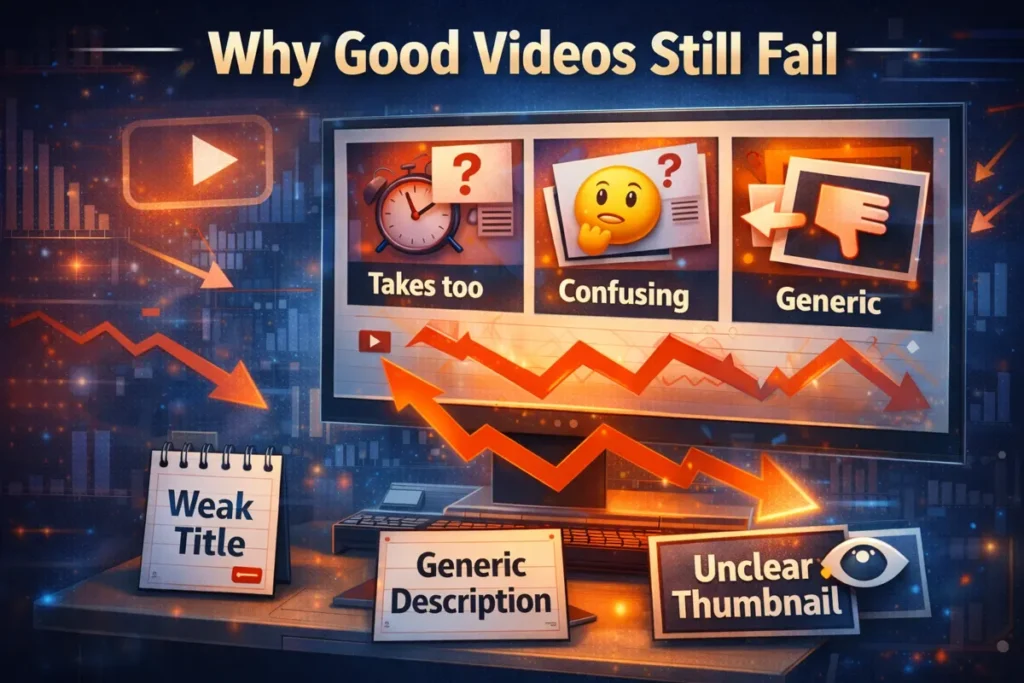
One of the most frustrating things on YouTube is this: sometimes a video is not bad at all, but it still does not perform.
That happens because a video is not judged only by how much effort went into it. It is judged by how clearly it communicates value.
A creator may think, “I made a useful video, so it should rank.”
But YouTube is not only asking whether the video is useful. It is also asking questions like:
- Is this video clearly relevant to the search?
- Does the title match what the viewer wants?
- Does the thumbnail make sense at a glance?
- Do viewers click when they see it?
- Do they stay long enough after clicking?
- Do they seem satisfied with the result?
That is why so many channels stay stuck. Their content is not always terrible. Their signals are just mixed.
The title promises one thing. The thumbnail suggests something else. The description feels generic. The audience gets confused. And YouTube does not reward confusion.
How YouTube Search Actually Works
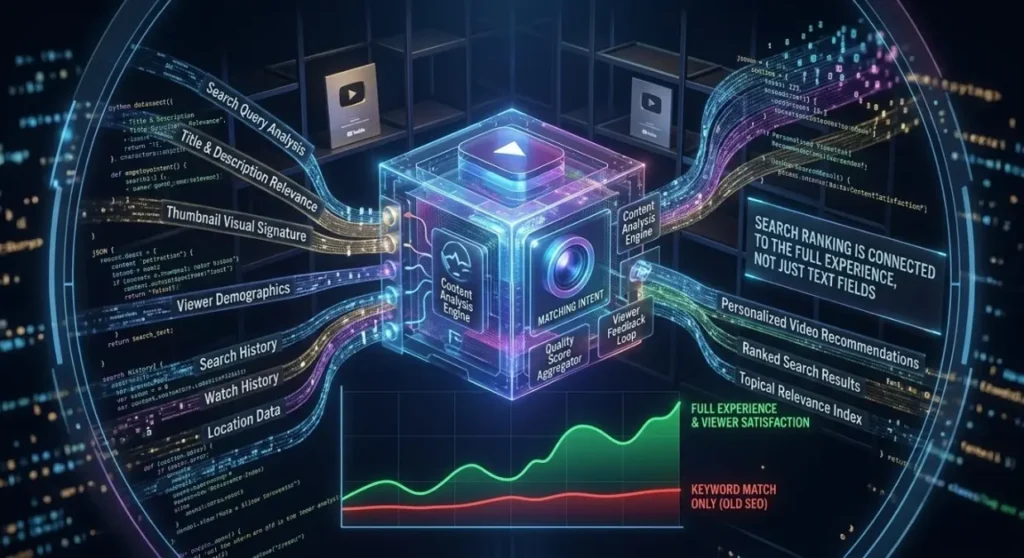
A lot of people think YouTube search works like old-school SEO. They assume that if the right keyword appears in the title, the video should rank.
YouTube Search considers relevance, engagement and quality. Titles, descriptions and the video content help establish relevance to a query. Home and Suggested recommendations are different surfaces with personalized viewer signals, so avoid treating every view as the result of keyword ranking.
YouTube’s official explanation of how Search works
For a tutorial, make the title describe the specific problem and ensure the video actually answers it. Use related wording only where it helps explain the topic; repeating the same phrase does not establish relevance by itself.
Because now the goal is not just to match a keyword. The goal is to match intent.
A video can technically include the keyword and still perform badly if the packaging is weak or the content feels slow and unfocused. Another video can outrank bigger channels simply because it gives clearer signals and satisfies the viewer faster.
That is why search ranking is connected to more than just text fields. It is connected to the full experience.
What It Really Means to Optimize Video for YouTube
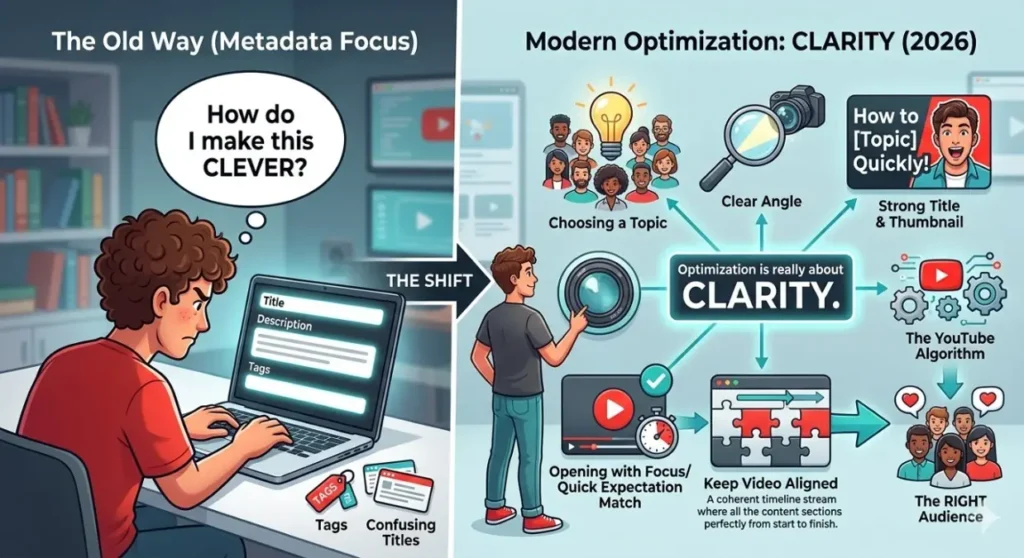
When people say they want to optimize video for YouTube, many of them still mean one thing: “Tell me what to write in the title, description, and tags.”
In 2026, optimizing a YouTube video means making the entire video easier for both the platform and the viewer to understand.
That includes:
- choosing a topic people actually care about
- creating a clear angle
- writing a strong title
- designing a thumbnail that supports the promise
- opening the video with focus
- matching the viewer’s expectation quickly
- keeping the video aligned from start to finish
Optimization is really about clarity.
The clearer your topic, promise, and delivery are, the easier it becomes for YouTube to test the video with the right audience.
The Title Is a Ranking Signal and a Click Signal
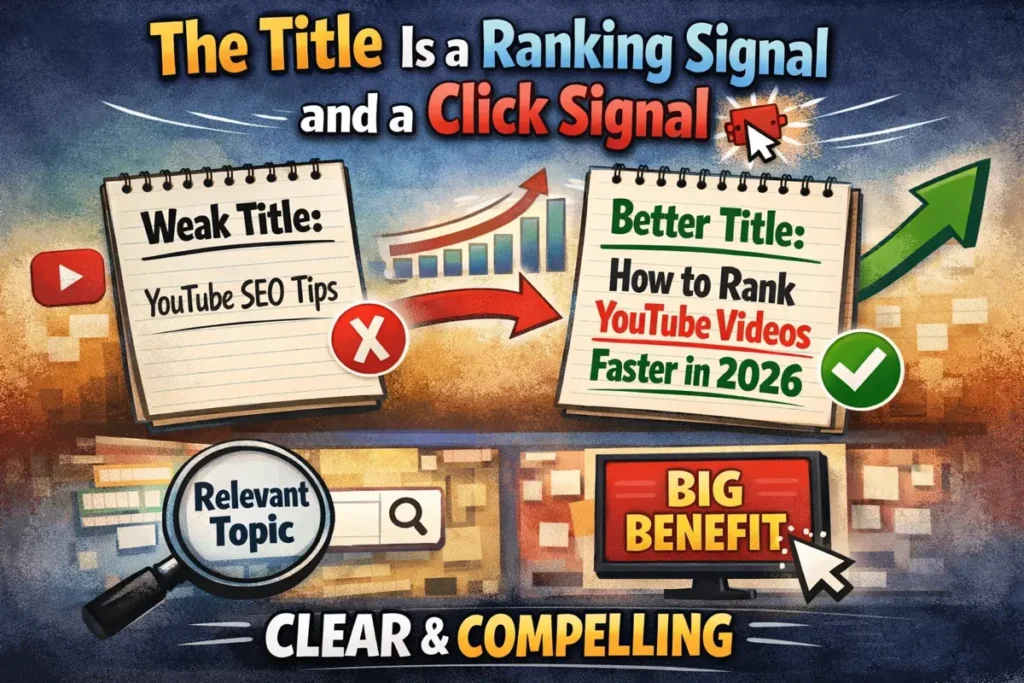
It helps YouTube understand the topic, and it helps the viewer decide whether the video is worth clicking.
A weak title may be technically relevant but still fail because it gives no compelling reason to care. A better title combines search intent with a specific benefit.
For example:
- Weak title: YouTube SEO Tips
- Better title: How to Rank YouTube Videos Faster in 2026
The second title is stronger because it is clearer. It tells the viewer what the video is about and why it matters now.
That does not mean you should stuff keywords into the title. It means the title should sound natural while still making the topic obvious.
Good titles are usually clear before they are clever.
Thumbnails Affect Ranking More Than People Admit
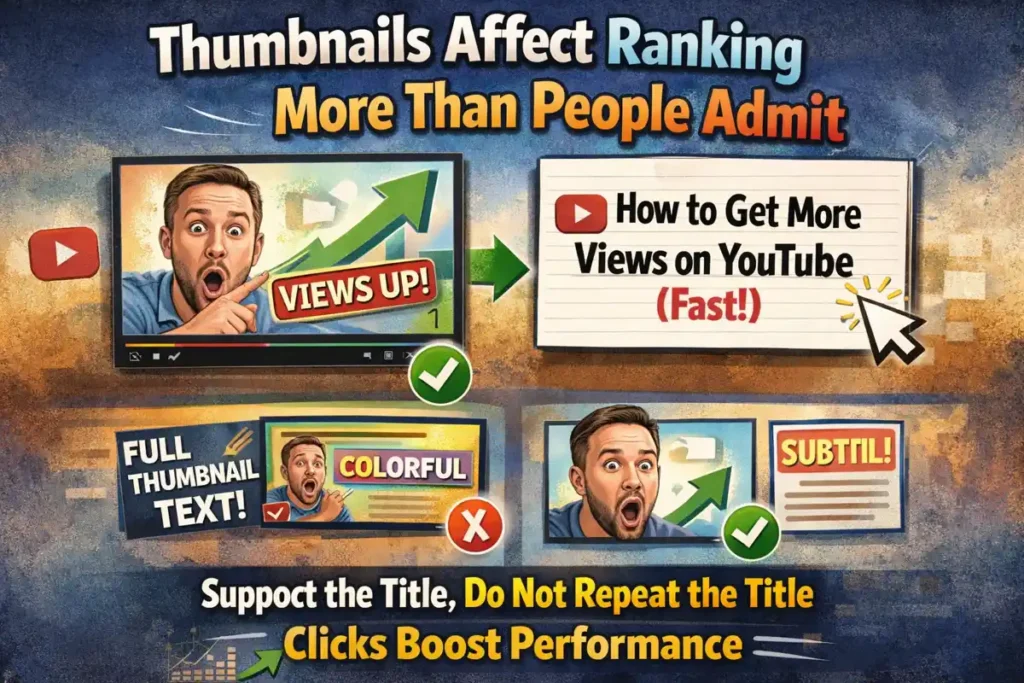
Thumbnails influence whether viewers choose to watch. A higher click-through rate alone does not guarantee better ranking: the audience, traffic source and whether the video satisfies the promise also matter. Compare similar videos and sources instead of chasing a universal CTR target.
A strong thumbnail does not need to be crowded. In fact, simple thumbnails usually work better. The image should be easy to understand quickly, even at a small size. It should create contrast, emotion, curiosity, or visual proof.
Most importantly, it should support the title instead of repeating it.
A common mistake is using too much text on the thumbnail and then saying the exact same thing again in the title. That wastes space. The title and thumbnail should work together, not copy each other.
When the packaging is strong, the video gets a better chance. When the packaging is weak, even a decent video can get ignored.
Descriptions Still Matter, But They Need to Sound Human
Descriptions are still useful, but not in the spammy way many people think.
A good description helps YouTube understand the topic and helps the viewer feel they are in the right place. A bad description either says almost nothing or repeats the same keyword over and over.
You do not need to force the same phrase into every second line. You need a clean description that explains the video naturally.
Write the first lines of the description as a clear summary of the video. Add useful chapters, sources or related videos where relevant. Do not add unrelated keywords, repeated phrases or promises that the video does not fulfill.
Related tutorial: Find and review a YouTube transcript
Tags and Channel Keywords Matter Less Than Most Creators Think
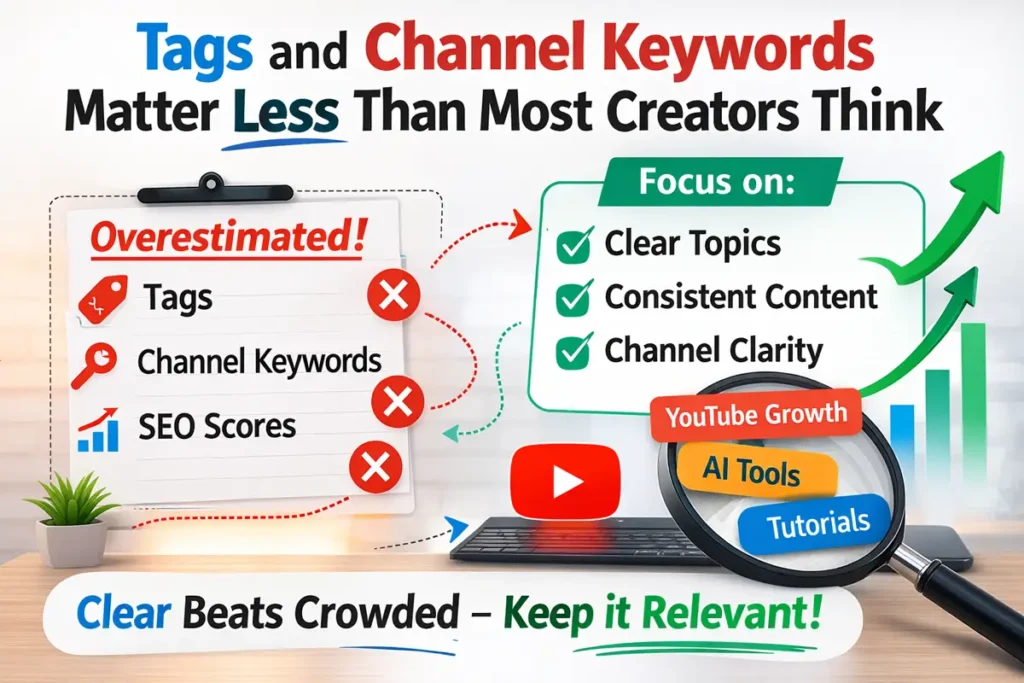
Tags can still help in some cases, especially when a word is commonly misspelled or has multiple variations. But they are not the main reason most videos rank.
Channel keywords describe your channel’s main topics. Keep them accurate and focused; they are not a substitute for useful videos, relevant titles or understanding your audience.
So if your channel is about YouTube growth, content strategy, AI tools, tutorials, or creator education, then your channel keywords should reflect that. They should describe what your channel consistently covers.
There is no fixed number of channel keywords that guarantees discovery. Remove irrelevant terms and do not spend more time on this field than on the video’s answer, packaging and viewer experience.
Clear beats crowded.
Why SEO Tools and Rank Trackers Are Helpful but Limited
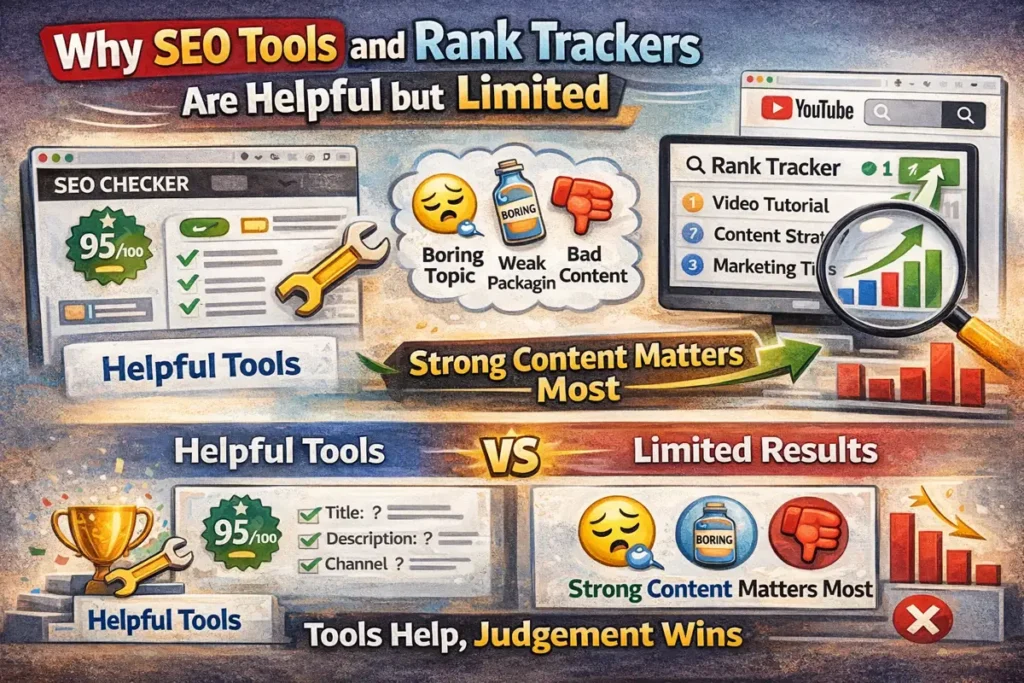
Tools can help, but they cannot fix a weak content strategy.
A YouTube channel SEO checker can point out missing basics. It might show that your title is weak, your description is empty, or your channel setup is incomplete. That is useful.
But a score from a tool is not the same as real channel health.
A video can have “good SEO” according to a browser extension and still perform badly because the topic is weak, the packaging is boring, or the first minute loses the viewer.
Related guide: AI Chrome extensions and permission checks
The same goes for a YouTube video rank tracker.
Rank trackers record a particular search snapshot, which can vary by location, time and personalization. Use them alongside actual YouTube Search traffic and search terms in Studio; Home, Suggested and external traffic should be evaluated separately.
Studio diagnosis checklist: Open YouTube Studio, select the video and open Analytics. In Reach, inspect traffic sources and the YouTube Search terms report when enough data is available. In Engagement, inspect retention for the opening and any sharp drops. Compare videos of similar length and the same traffic source; small samples can mislead.
What not to do: buy views or engagement, mislead viewers with titles, repeat unrelated keywords, or change several elements at once and attribute the result to one of them. Keep the original comparison period and traffic source in your notes.
If impressions exist but clicks are weak, review whether the title and thumbnail communicate the correct promise. If viewers leave early, shorten setup and bring the useful answer forward. If Search traffic is small, check query demand and whether the video answers that query. Record one meaningful change and review the response without promising a fixed deadline.
That is why smart creators use tools as support, not as a replacement for judgment.
Tools can tell you what exists.
They cannot tell you whether people truly care.
SEO Video Marketing Is Bigger Than Metadata
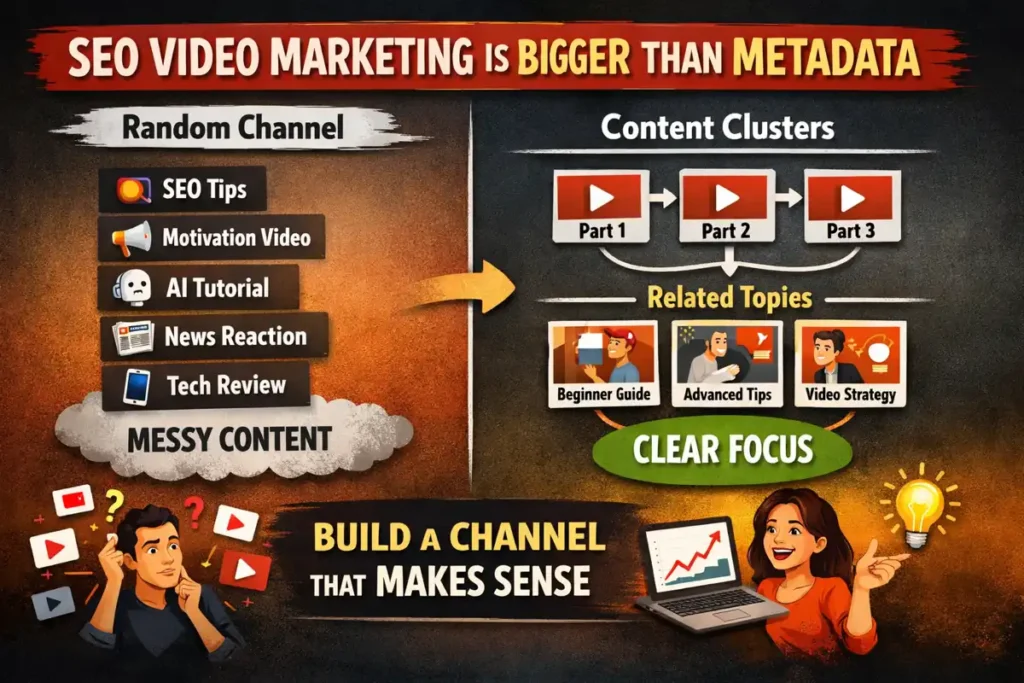
When people hear the phrase SEO video marketing, they often think about titles, descriptions, and tags.
But the real picture is much bigger than that.
Good video SEO is tied to content strategy. It is connected to topic selection, viewer intent, packaging, retention, and the relationship between one video and the next.
YouTube does not just look at isolated uploads. Over time, it also learns what your channel is about, who tends to watch it, and what kind of content your audience responds to.
That is why random channels often grow slowly.
One week they upload a YouTube SEO video.
Then a motivation video.
Then an AI tutorial.
Then a random news reaction.
Then a tech review.
Even if some of those videos are fine, the channel signal stays muddy.
Related videos can give interested viewers a useful next step. They do not guarantee faster growth or create an automatic channel-wide ranking boost. Measure whether viewers actually continue to the related videos.
One good video can get lucky.
A clear content system grows more steadily.
So if you want better long-term results, think in clusters.
What topic naturally leads to the next one?
What beginner question comes after this video?
What should the viewer watch next when this one ends?
That is where real SEO video marketing becomes powerful. It is not just about ranking one upload. It is about building a channel that makes sense.
How Related Videos Support the Viewer’s Next Step
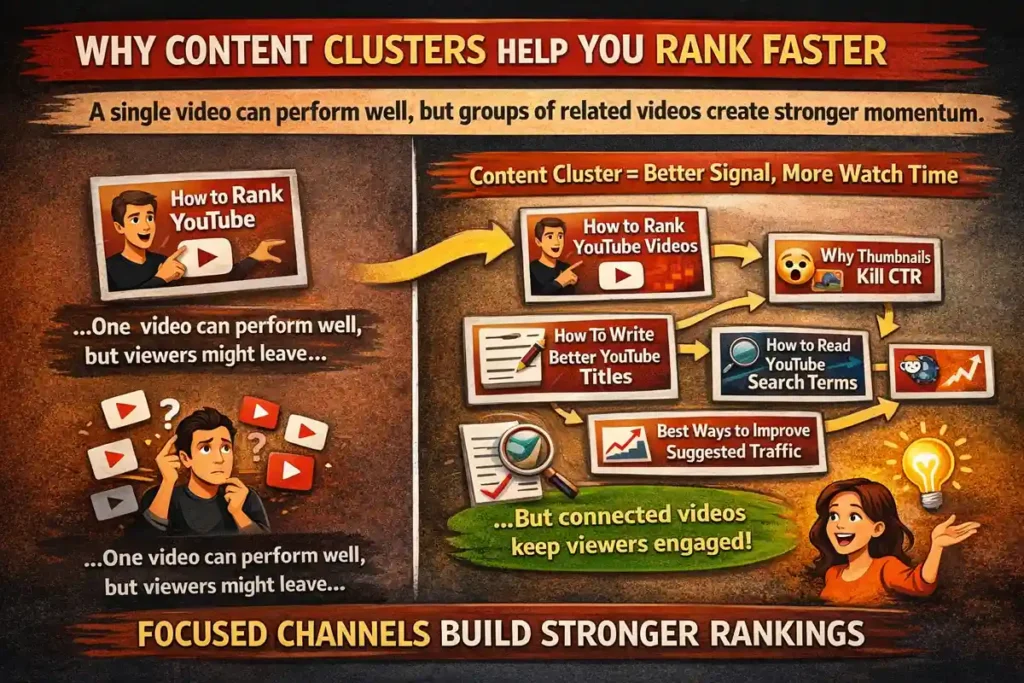
Related tutorials can form a useful learning sequence, but each video still needs to satisfy its own audience. Link a relevant next step through a playlist or end screen where eligible, then check the audience response.
When several videos cover connected topics, YouTube gets clearer signals about your niche. The viewer also has a better reason to keep watching your channel instead of leaving after one upload.
For example, if one video is about how to rank YouTube videos, the next videos could cover:
- how to write better YouTube titles
- why thumbnails kill click-through rate
- how to read YouTube search terms
- why retention matters more than tags
- best ways to improve suggested traffic
Now the channel starts looking focused.
A coherent topic sequence is an editorial strategy, not a guaranteed ranking shortcut. Test it using viewing behavior and meaningful traffic rather than a promised time-to-rank.
How to Rank YouTube Videos Without Sounding Fake
If someone asked for the most honest answer to how to rank YouTube videos, it would not begin with technical tricks.
It would begin here:
- Make videos about things people genuinely care about.
- Package them clearly.
- Tell viewers what they are getting.
- Deliver on that promise quickly.
- Help YouTube understand the topic without stuffing the page with junk.
That is the real answer.
Many creators stay hidden not because they missed one small optimization trick, but because the video never sends a strong, consistent message.
The topic is unclear.
The title is vague.
The thumbnail is weak.
The introduction wanders.
The viewer loses interest.
The platform sees that response.
And the video slows down.
Better rankings usually come from better alignment, not smarter loopholes.
A Simple Framework to Improve Video Ranking
If your goal is better video ranking and more views, keep the process simple.
Before You Upload
- Choose a topic people are actually searching for or clearly interested in.
- Make sure the angle is specific enough to stand out.
- Write a title that is easy to understand and gives a reason to click.
- Create a thumbnail that adds tension, contrast, curiosity, or proof.
- Open the video in a way that quickly confirms the viewer made the right choice.
After You Upload
- Check whether people are actually clicking when the video is shown.
- See whether the first part of the video is holding attention.
- Look at what search terms or traffic sources are bringing viewers in.
- Pay attention to what is working across multiple videos, not just one.
- Use end screens and related uploads to keep viewers inside your channel.
This is where many creators improve. They stop guessing and start learning from real audience behavior.
Final Thoughts on Long-Term Growth
If you want your videos to rank higher, do not spend all your energy chasing tiny tricks.
Focus on sending clearer signals than your competitors.
Make the topic obvious.
Make the benefit obvious.
Make the click feel worth it.
And once someone clicks, make the value show up fast.
That is how you really optimize a YouTube video.
Not by stuffing metadata.
Not by relying on channel keywords.
Not by obsessing over a checker score.
And not by staring at a rank tracker all day while ignoring the actual content.
The channels that grow are usually not the ones doing the most tricks.
They are the ones making better promises, delivering faster, and building a clearer system around their content.
Frequently Asked Questions
What does optimize video for YouTube mean?
It means improving the parts of your video that help both YouTube and viewers understand it better. That includes the topic, title, thumbnail, description, and how well the content keeps people watching.
What is channel keywords YouTube meaning?
Channel keywords are keywords added in your channel settings to describe the overall topic of your channel. They can support clarity, but they are not a major ranking shortcut by themselves.
How many channel keywords should I use on YouTube?
There is no magic number that guarantees growth. The better approach is to use a focused set of keywords that genuinely describe your channel’s real content instead of stuffing unrelated phrases.
Do tags still matter for YouTube SEO?
Yes, but much less than many creators think. They can still help with misspellings or keyword variations, but they are not the main driver of discovery for most videos.
Is a YouTube channel SEO checker enough to fix a weak channel?
No. It can help you catch missing basics, but it cannot fix poor topic choice, weak packaging, low viewer interest, or bad retention.
What does a YouTube video rank tracker do?
It tracks where your video appears for selected keywords over time. That can be useful, but ranking alone does not tell the full story. You still need to look at viewer behavior, clicks, and traffic sources.
