
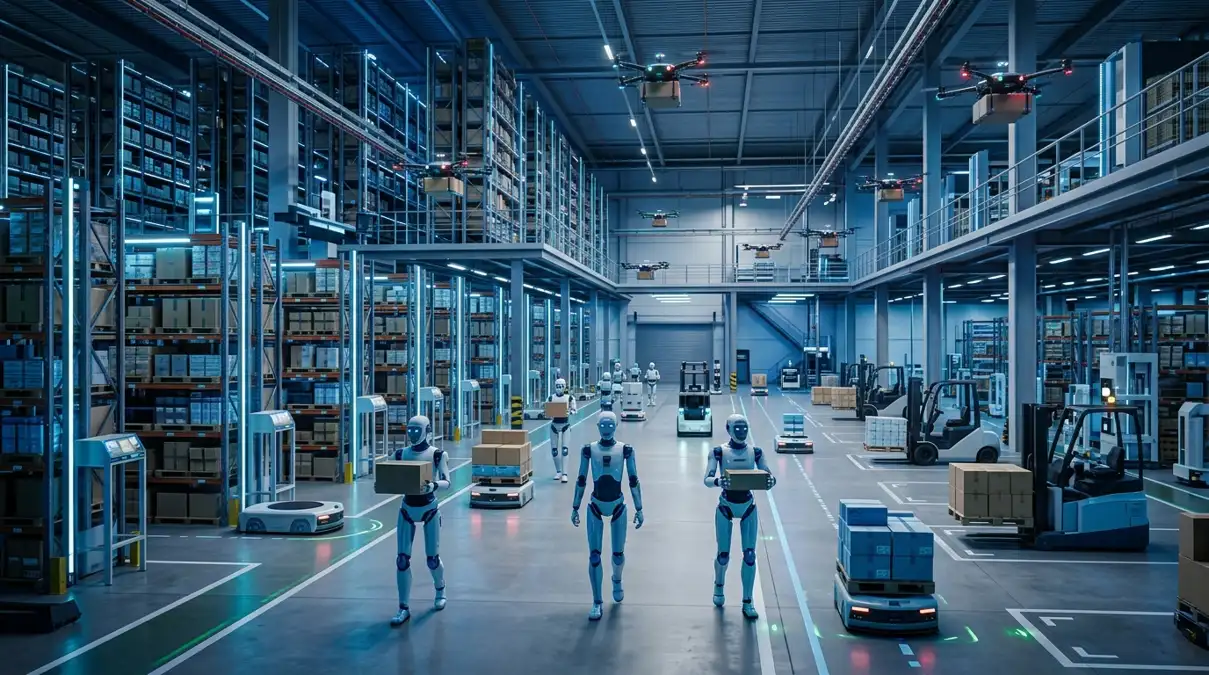
Last year, the warehouse down the road from an Amazon fulfillment center in Shreveport, Louisiana ran 24 hours a day almost entirely without human hands touching a single package. Robotic arms sorted, autonomous carts moved, AI systems predicted what to stock before orders even arrived. What looked like science fiction three years ago is now just a Tuesday afternoon in American logistics.
Warehouse robotics is no longer a pilot program or a budget line item executives debate. It is the operating model. And in 2026, the news coming out of this space is moving faster than most trade publications can keep up with from billion-dollar investments to humanoid robots walking GXO distribution floors right now.
This is the full picture of what is actually happening in warehouse and logistics robotics today.
Related: If you want to understand the AI infrastructure powering these automated systems, our breakdown of Agentic AI News: Latest Trends and Business Use Cases in 2026 covers exactly how these intelligent systems are being built and deployed.
Why Warehouse Robotics Is Growing Fast in 2026
Three things collided at the same time and created a situation the logistics industry had no real answer for except automation.
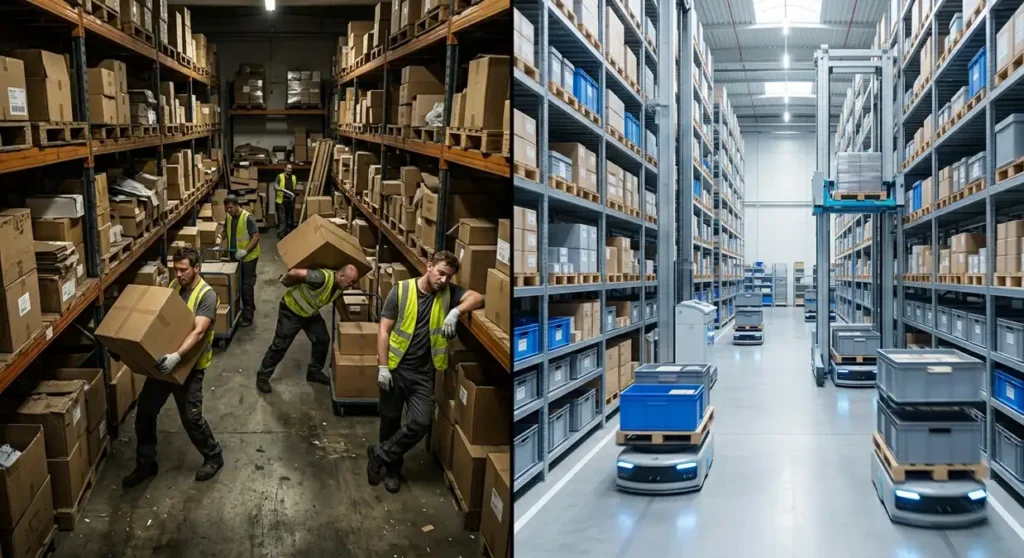
The labor problem is not going away. Warehouse and transportation job openings consistently outnumber available workers. Turnover in fulfillment centers runs between 100% and 150% annually at many facilities. Hiring, training, and replacing workers costs an average of 33% of their annual salary each time. For companies running thousands of employees across dozens of locations, that math becomes unsustainable fast.
E-commerce volume has no ceiling in sight. Global parcel volume is on track to exceed 262 billion packages by the end of 2026. The expectation of next-day or same-day delivery — now considered standard by American consumers requires a speed and accuracy that human-only operations simply cannot consistently deliver at scale.
The cost of robots dropped dramatically. The average cost of an industrial robot fell from $46,000 in 2010 to under $11,000 by mid-decade. Autonomous Mobile Robots that previously required massive capital investment can now be leased under Robotics-as-a-Service (RaaS) contracts — monthly payments instead of million-dollar purchases. That shift opened the door for mid-sized logistics companies that previously could not justify the upfront cost.
The result: the global warehouse automation market sits at $29.98 billion in 2026 and is on track to reach $59.52 billion by 2030, growing at 18.7% annually. Around 4.7 million commercial warehouse robots are now installed across more than 50,000 warehouses worldwide. In 2019, 75,000 logistics robots were sold globally. In 2025, that number was 450,000 a 500% increase in six years.
Sixty percent of warehouses surveyed have already committed to increasing their automation budgets by at least 20% this year. This is not a trend. It is a structural shift.
Latest Warehouse Robotics News and Industry Updates
The pace of real deployments not announcements, not concept demos has accelerated sharply in early 2026. Here is what is actually happening on warehouse floors right now.
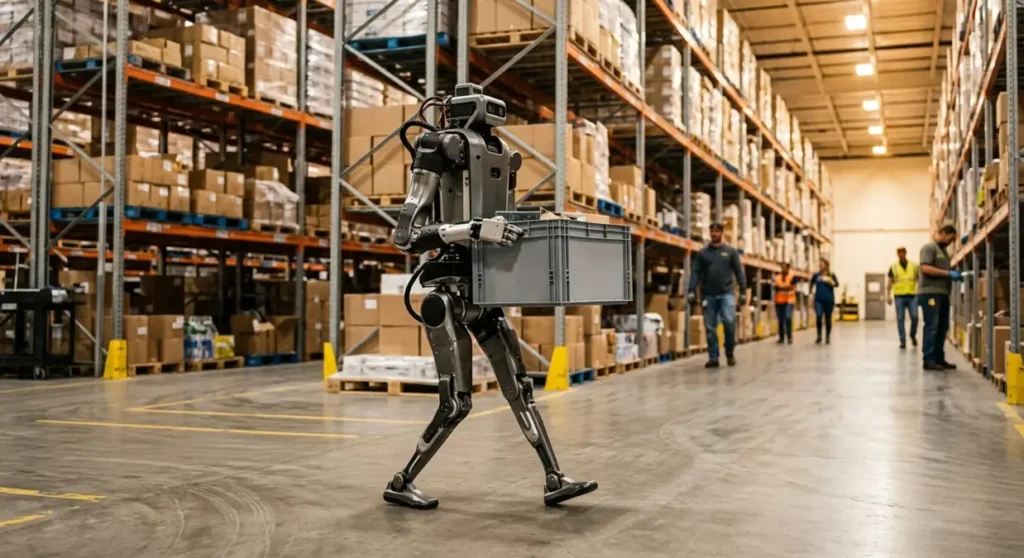
Agility Robotics and GXO At a GXO Logistics distribution center in Flowery Branch, Georgia, Agility Robotics’ Digit humanoid robots are now moving merchandise commercially. Digit crossed 100,000 totes moved in a live commercial environment a milestone that shifted the conversation from “will humanoids work in warehouses” to “how many do we need.” Agility then announced a second deployment in San Antonio, Texas, handling fulfillment operations for Mercado Libre. Two live commercial sites, real throughput numbers.
Amazon’s Robot Fleet Amazon now operates more than 750,000 robots across its fulfillment network. Three systems define its current approach: Vulcan, an AI-driven robotic arm with actual tactile sensing that can feel what it is touching; Cardinal, which stacks packages intelligently before truck loading; and Proteus, an autonomous mobile robot that moves carts independently through the facility. Robin, a robotic arm sorting packages for outbound shipping, has already completed over three billion successful package moves across Amazon facilities.
DHL’s Scale DHL now operates more than 7,500 autonomous warehouse robots across its network in 220 countries. Over 90% of their warehouses have at least one automated solution in place. Workers who previously walked close to a half marathon daily just moving through massive warehouses have seen that dramatically reduced by autonomous robots that unload containers at 650 cases per hour — a number no human team matches.
UPS’s $9 Billion Bet UPS committed $9 billion to its automation plan, including $120 million specifically for robots that help unload trucks. By end of 2026, UPS plans to run 68% of its U.S. volume through automated facilities, up from 66.5% at year-end 2025. CEO Carol Tomé confirmed the company deployed automation in 57 buildings in Q4 2025 alone, bringing its total to 127 automated buildings.
FedEx + Berkshire Grey FedEx partnered with Berkshire Grey to create what they call “physical AI” for smarter logistics — a fully autonomous robot for unloading containers and optimizing operations that is now running at the Memphis hub, with expansion planned across its Network 2.0 initiative.
Dexory UK-based Dexory launched its next-generation autonomous warehouse intelligence robot in February 2026, combining real-time scanning with AI-powered Storage Health software. Its platform is already running for GXO, Maersk, and DHL three of the largest logistics operators in the world.
How AI Is Changing Warehouse Automation
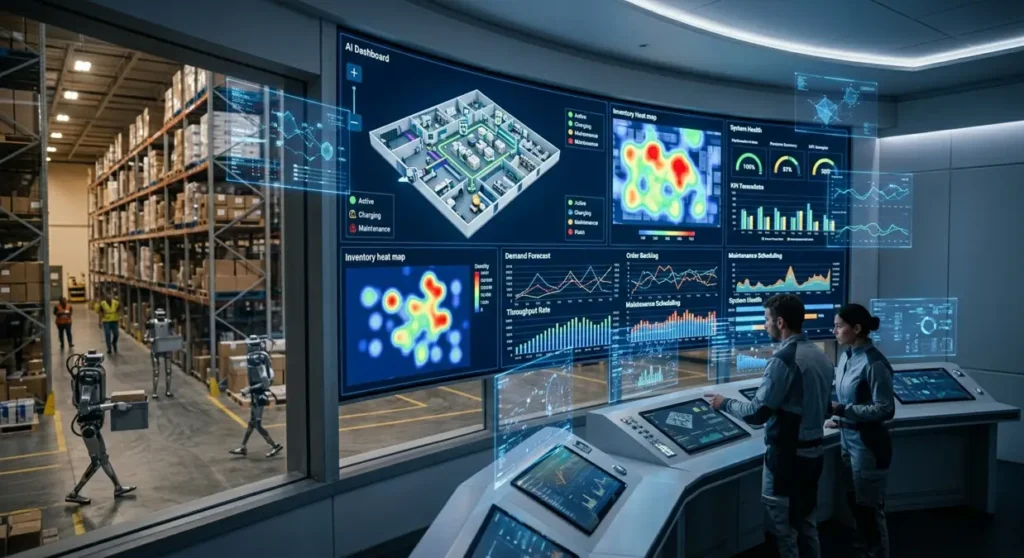
The robots themselves are only half the story. The AI systems directing them are where the real transformation is happening and the gap between companies that understand this and those that don’t is widening fast.
Traditional warehouse robots followed fixed paths. You programmed them, they followed. Any change to the layout meant reprogramming. That model is gone. Today’s systems use machine learning to plan their own optimal routes in real time, adapt when inventory changes, reroute around obstacles, and improve their own performance the longer they run.
What AI specifically adds to Warehouse Robotics News:
Autonomous Mobile Robots now navigate complex layouts with minimal human input, learning from the environment rather than following predetermined tracks. Computer vision systems trained on millions of product images allow robotic picking arms to identify and handle items they have never physically encountered before — reducing the need for manual programming of every SKU.
Predictive maintenance powered by AI monitors robot performance and flags potential failures before they happen, reducing machine downtime by 30–40% according to McKinsey data. In a 24/7 warehouse operation, an unexpected robot failure during peak hours is not just an inconvenience — it is a cascading disruption that costs tens of thousands of dollars per hour.
Digital twins — AI-generated virtual replicas of an entire warehouse — allow operators to test changes before implementing them. DHL uses this technology to model how shifting a storage location, changing transportation mix, or adjusting labor allocation would affect delivery speed across its entire network before a single physical change is made.
The software side of AI-driven warehouse automation is expanding at 27% annually and is projected to reach $31.5 billion by 2032. That number growing faster than hardware sales tells you something important: the industry understands that the robot body is commoditizing. The intelligence directing it is where value gets created.
For a deeper look at how AI inference — the technology that runs these models in real time — is being built, our guide on Top Innovative AI Inference Vendors to Watch in 2026 covers the infrastructure layer in detail.
Key Companies in Warehouse and Logistics Robotics
The Warehouse Robotics News space has no shortage of players. These are the ones actually moving product at scale right now — not just raising money.
Amazon Robotics — The largest private robot fleet on earth. Amazon’s robotics division is the de facto R&D lab for warehouse automation at scale. Vulcan, Cardinal, Proteus, Robin — each system targets a specific bottleneck in the fulfillment process. The company has invested over $1 billion in automation for its fulfillment centers and continues expanding. Note: Amazon’s robotics division did cut roughly 100 corporate positions in early 2026 — a sign of restructuring toward AI-first development rather than traditional engineering headcount.
GXO Logistics — GXO operates one of the most automation-forward third-party logistics networks in the world. The company uses collaborative robots, vertical lift modules, advanced sorting systems, and now humanoid robots through its Agility Robotics partnership. GXO’s model — outsourced logistics with heavy automation — is increasingly the benchmark other 3PLs are chasing.
DHL Supply Chain — 7,500+ autonomous robots, 10,000 automation projects since 2020, and coverage across 95% of its global warehouses. DHL’s partnership with Boston Dynamics for the Stretch robot — which autonomously unloads trailers at high speed — is one of the clearest examples of commercial humanoid-adjacent robotics working reliably in production.
Agility Robotics — The company behind Digit, currently the most commercially deployed bipedal humanoid in warehouse environments. Two live commercial sites as of April 2026. Backed by Amazon. Moving fast.
Boston Dynamics — Stretch is already operating in DHL facilities. Atlas, the fully electric humanoid introduced at CES 2026 in partnership with Google DeepMind, is headed to Hyundai’s Georgia factory. Boston Dynamics is the only company with two distinctly different commercial robots deployed at enterprise scale.
Dexory — Rapidly becoming the standard for warehouse intelligence. Their autonomous robot-plus-AI platform gives operators real-time visibility into what is actually happening across a warehouse floor in a way that fixed camera systems cannot. GXO, Maersk, and DHL trust it. That is meaningful validation.
Walmart and Nike — Both are worth watching as non-logistics companies deploying serious automation. Walmart now runs 60% of its stores supplied from automated distribution centers. Nike uses robotic arms and AI cameras in its distribution centers for material cutting and quality control. When consumer brands this size invest this heavily, the supply chain vendors serving them follow.
Benefits of Warehouse Robotics for Speed and Cost

The business case for Warehouse Robotics News in 2026 is not theoretical. The numbers from live deployments are in, and they are significant enough that the question has shifted from “is this worth it” to “why haven’t we started yet.”
Speed gains are real and measurable. DHL’s item-picking robots increased units picked per hour by 30% at measured facilities. Autonomous forklifts at the same locations contributed a 20% efficiency increase. One 3PL — Netrush — cut labor requirements for picking and replenishment by over 75% after deploying AI-driven automation. Saddle Creek Logistics doubled productivity using Locus AMRs without adding headcount.
Operating hours go from 16 to 24. A human workforce cannot run continuously without fatigue, safety concerns, and overtime costs. Robots running standard 16–24 hour continuous operation shift the productivity math entirely. Combined with AI systems that optimize routes and tasks in real time, facilities that previously ran two-shift operations are achieving three-shift output with the same or smaller physical footprint.
Space efficiency is dramatically better. Automated Storage and Retrieval Systems (ASRS) can increase storage density by 4x within the same building footprint. Vertical lift modules use full ceiling height rather than accessible shelf height. Advanced systems achieve up to 80% floor space savings compared to manually navigated shelf configurations. For warehouse operators in markets where real estate costs are climbing, this is not a minor operational improvement — it is a fundamental change in what a facility can handle per square foot.
ROI timelines have shortened. Three to five years was the standard payback period cited in previous years. AMRs in current live deployments are delivering payback in 18 to 36 months. Some operations see measurable ROI within the first eight months by targeting the highest-volume bottlenecks first — often cutting manual labor costs by 20–30% in the initial weeks of deployment.
Error reduction changes the downstream math. Robotic picking systems reduce picking errors by up to 90% compared to human-only picking. If errors cost a warehouse $100,000 annually, that single improvement saves $90,000 per year. Multiply across thousands of SKUs and millions of orders, and the accuracy advantage compounds into a significant competitive differentiator in customer retention and return rate management.
The broader economic picture: robotics and automation are expected to reduce overall logistics expenses by up to 40% for fully automated operations. That figure sounds aggressive until you look at what Amazon’s most automated fulfillment centers are already demonstrating.
Understanding how to evaluate these tools before investing is critical. Our guide on Best AI Tools for Business in 2026 walks through how to assess AI-driven automation investments in practical business terms.
Workforce Impact and Operational Challenges
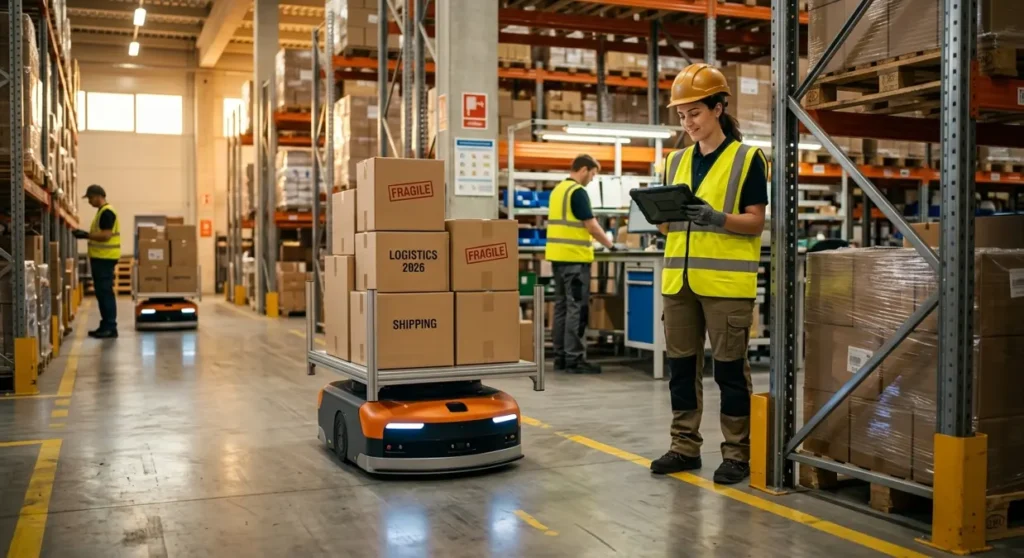
The workforce conversation around Warehouse Robotics News is more complicated than most coverage admits. There are real job losses. There are also real job shifts. Both are happening simultaneously, and neither side of the debate is being entirely honest about it.
What is actually being displaced: The most vulnerable roles are high-repetition, low-complexity tasks — moving items from point A to point B, basic sorting, trailer unloading, single-SKU picking runs. These are exactly the roles where automation delivers the clearest ROI and where robot reliability is highest. Amazon’s internal projections have suggested automation could reduce future hiring needs by 160,000+ people by 2027, though the company disputes how that number has been characterized publicly.
What is growing: Technical maintenance roles, robot fleet supervisors, automation systems coordinators, and data analysts managing AI systems. UPS explicitly says its automation strategy “redirects” hiring toward technical roles rather than eliminating job growth entirely. FedEx frames its robotics investment as “enhancing worker jobs” by removing the most physically punishing tasks. Whether those framing choices reflect genuine outcomes or PR management depends on which facility you visit and what data you look at.
The physical reality for workers who remain: At DHL, workers who previously walked half a marathon daily now work alongside systems that handle the physical burden. That part is genuinely real. Warehouse injury rates — back injuries from lifting, foot injuries from constant walking on concrete — are an enormous and underreported cost in the logistics industry. Automation addresses these directly.
The operational challenges that money doesn’t immediately solve:
Integration complexity is the most underrated obstacle. Legacy warehouse management systems were not built to communicate with AMR fleets, AI picking systems, and real-time digital twins simultaneously. Connecting these systems without disrupting existing operations is expensive, slow, and requires expertise most logistics operators do not have internally.
McKinsey research on warehouse automation projects found that a significant portion fail — not because the technology doesn’t work, but because organizations lack a cohesive vision, leadership doesn’t understand the technology deeply enough, and internal teams are misaligned on what success looks like. A consumer goods company invested over $150 million in a fully automated facility that ended up primarily handling wholesale fulfillment — not the e-commerce fulfillment it was designed for. The automation worked. The strategy didn’t.
Cybersecurity exposure grows with every connected robot and AI system added to a warehouse network. A fleet of 500 AMRs represents 500 networked endpoints. The logistics industry’s cybersecurity investment has not kept pace with its automation investment — a gap that is increasingly being exploited.
The broader question of how technology is reshaping work and activity across industries is something we’ve covered in depth. See How Technology Has Affected People’s Activity Levels in 2026 for the wider context.
What’s Next for Warehouse Robotics News?
The trajectory from here is clearer than it has been at any point in this industry’s history — not because everything is solved, but because enough live deployments now exist to project forward with real data rather than vendor projections.
Humanoids enter warehouses at scale. The Agility Robotics Digit deployment at GXO is not an experiment anymore. It is a commercial contract with measurable throughput numbers. As unit costs for humanoid robots fall toward the $20,000–$30,000 range that Tesla is targeting for Optimus, the ROI calculation for warehouse operators shifts from “can we justify this” to “can we afford not to.” Boston Dynamics’ Atlas at Hyundai’s Georgia plant will generate the kind of real-world performance data the industry needs to move faster. Expect the number of commercial humanoid deployments in warehouses to triple by end of 2026.
RaaS replaces CapEx as the dominant model. ABI Research projects 1.3 million Robotics-as-a-Service installations by end of 2026, generating over $34 billion in revenue. The shift from upfront purchase to monthly subscription removes the single biggest barrier to adoption for mid-market logistics operators. Seventy-two percent of logistics firms are actively planning to adopt RaaS contracts. This changes who can afford automation — which changes how fast adoption happens.
AI gets embedded deeper into the physical robot. The current model — cloud-connected robots that process decisions remotely — has latency limitations in fast-moving environments. Edge AI, where the robot’s own onboard processor handles decision-making in real time without waiting for a cloud round trip, is the next architecture. Faster response, better reliability, and operation in environments with poor connectivity. This is where companies like NVIDIA are placing significant bets, and the AI inference infrastructure supporting this shift is already being built.
Sustainability becomes a selection criterion. Automated systems use energy more efficiently than labor-intensive equivalents. They run optimized routes rather than human-intuitive ones. They reduce returns (through higher accuracy) and packaging waste (through better space utilization). As ESG requirements tighten for large logistics operators, automation’s sustainability profile moves from a nice-to-have to a procurement requirement.
Five things logistics businesses should watch before December 2026:
First, the Agility Robotics Digit throughput data from its second GXO deployment — the first site showed proof of concept, the second site will show whether it scales.
Second, Tesla Optimus Gen 3’s commercial availability timeline — if external customers can access Optimus units by Q4 2026 at the rumored $20,000–$30,000 price point, the warehouse ROI math changes overnight.
Third, UPS’s 68% automation target — will they hit it, and what does the operational data look like when they do?
Fourth, the RaaS adoption rate among mid-market 3PLs — this is where the next wave of growth comes from, and it’s largely invisible in mainstream coverage.
Fifth, the first major warehouse cybersecurity incident linked to a robot fleet — it hasn’t happened publicly yet, but the exposure is there and growing.
Muhammad Hanif covers AI infrastructure, robotics, and technology trends at Smart Tech Ideas — focused on translating fast-moving industry developments into clear, actionable information for business and tech readers. Questions or updates? Drop a comment below.
Related Reading on Smart Tech Ideas
- Agentic AI News: Latest Trends and Business Use Cases in 2026
- Top Innovative AI Inference Vendors to Watch in 2026
- Best AI Tools for Business in 2026
- Technology Trends 2026: AI and Cybersecurity
- How Technology Has Affected People’s Activity Levels in 2026
- Developing an Agentic AI System: A Practical Guide for 2026
Frequently Asked Questions
What is warehouse robotics?
Warehouse Robotics News refers to automated machines — from robotic picking arms and autonomous mobile robots (AMRs) to humanoid robots and AI-guided forklifts — deployed inside warehouses and distribution centers to handle tasks like picking, packing, sorting, moving inventory, and unloading trucks. Unlike traditional fixed machinery, modern warehouse robots use AI and sensors to navigate dynamically, adapt to changes, and work alongside human employees.
How much does warehouse automation cost in 2026?
It varies widely. AMRs can be leased under RaaS contracts for monthly fees far below previous purchase prices, with many deployments achieving ROI in 18–36 months. Full facility automation for large operations runs $5 million to $50 million. The key shift in 2026 is that mid-market operators can now access robots through subscription models rather than requiring massive upfront capital.
Which companies are leading in warehouse robotics right now?
Amazon (750,000+ robot fleet), DHL (7,500+ autonomous robots), GXO (humanoid and AMR deployments), Agility Robotics (commercial humanoid deployments), Boston Dynamics (Stretch and Atlas), Dexory (warehouse intelligence platform), and FedEx with Berkshire Grey are the operations and vendors generating the most credible live deployment data in 2026.
Are warehouse robots replacing human jobs?
Some roles are being displaced — particularly high-repetition, low-complexity tasks like trailer unloading, basic sorting, and single-item picking runs. At the same time, technical roles in robot maintenance, fleet supervision, and AI system management are growing. The honest answer is that both things are true simultaneously, and the net effect varies significantly by company, region, and how aggressively automation is being deployed.
What is the ROI of Warehouse Robotics News?
AMRs in live deployments are showing ROI above 250% with payback periods of 18–36 months in well-implemented projects. Robotic picking reduces errors by up to 90%. DHL’s autonomous robots increased picking efficiency by 30% and forklift operations by 20%. A 42% five-year OPEX reduction is documented in multiple case studies. Results depend heavily on implementation quality and targeting the right bottlenecks first.
What is RaaS and why does it matter for logistics?
Robotics-as-a-Service (RaaS) is a subscription model where companies pay monthly usage fees for robot deployments rather than purchasing the hardware outright. It dramatically lowers the barrier to entry for mid-sized logistics operators, converts large capital expenditures into predictable operating costs, and allows companies to scale robot fleets up or down based on demand. 72% of logistics firms are actively planning RaaS adoption in 2026.
