

Updated October 9, 2026. Agentic AI news now covers enterprise agent platforms, workplace workflows and the controls needed before software can take actions. The confirmed announcements below are dated individually; product announcements are not proof of measured business results.
Not long ago, most people were asking a simple question: which AI chatbot is best? Now the question is different. People want to know which AI system can actually do things. Not just answer. Not just summarize. Not just throw ideas on the screen. The real interest now is in systems that can research, make decisions, use tools, move through multi-step workflows, and help finish actual work.
That is exactly why agentic AI news is suddenly everywhere.
And to be fair, the excitement is not made up. In early 2026, OpenAI launched Frontier for enterprise AI agents, Microsoft expanded its push into agent-style workflows with Copilot Cowork, and Nvidia centered GTC 2026 around agents, inference, robotics, and the infrastructure needed to move AI from demos into production. That is a strong signal. The market is shifting from AI that mainly responds to prompts toward AI that can work through tasks over time.
Still, this is where confusion starts.
Not every chatbot is an agent. Not every workflow automation tool is agentic AI. And not every company using the word “agent” is doing anything truly new. A lot of noise is mixed in with the real progress. So if you searched this topic because you want a clean explanation plus the latest updates, this guide is for you.
Let’s keep it simple, practical, and honest.
What Is Agentic AI and Why Is It Trending?

A regular chatbot is reactive. You type a question. It gives an answer. Done.
Agentic AI goes further. You give it a goal, and it can break that goal into steps, decide what to do first, use tools, pull data, handle follow-ups, and sometimes keep working until the task reaches a finish line. MIT Sloan describes agentic AI as a broader concept than a basic AI agent, often involving systems that plan, act, and coordinate across tasks rather than only responding to one prompt at a time.
Architecture guide: Developing an agentic AI system
That difference matters.
A chatbot can draft a support reply. An agentic system can classify the ticket, look up account details, suggest the right answer, update the CRM, and route the case if the issue looks risky. One is a helpful assistant. The other is much closer to a digital worker.
So why is it trending now?
Because companies are no longer interested in AI that looks impressive for five minutes and then creates more work for the team. They want useful systems. They want AI that removes repetitive tasks, speeds up routine decisions, and fits into the tools they already use. OpenAI’s Frontier platform is built around helping businesses deploy and manage agents, while Microsoft’s Copilot push is moving deeper into multi-step productivity work. Nvidia is pushing the infrastructure layer that makes these systems faster and easier to run at scale. In other words, the software story and the infrastructure story are now moving together.
That is why this trend feels bigger than another short AI hype cycle.
It is not just about better answers anymore. It is about better execution.
Agentic AI News: Confirmed Announcements and Dates

The biggest stories in this space all point in the same direction.
February 5, 2026 — OpenAI introduced Frontier, a platform for businesses to build, deploy and manage AI agents. Its enterprise focus includes shared business context and controls around agent work. A launch announcement describes capabilities and intended use; buyers still need to test reliability and integration in their own workflows.
March 9 and March 31, 2026 — Microsoft announced Copilot Cowork in a research preview built with Anthropic, then made it available through the Frontier program. These rollout dates matter: a preview or early-access release should not be described as universally available to every Microsoft 365 customer. Check the current documentation and your tenant eligibility before planning deployment.
Third, Nvidia’s GTC 2026 messaging made it obvious that agents are now tied to inference, orchestration, and production infrastructure. Nvidia’s own AI materials frame agentic AI as a full stack challenge involving deployment, lifecycle management, and optimized inference. That matters because real agents need more than a flashy demo. They need speed, controls, monitoring, and a reliable way to run at scale.
Read each announcement with three questions in mind: what was released, who can access it, and which capabilities have been demonstrated or independently evaluated? That distinction keeps an agentic AI news roundup useful after the initial launch headlines.
Okta Blueprint Alliance announcement — September 22, 2026
Google Cloud and Wells Fargo announcement — August 5, 2025
Microsoft Copilot Cowork rollout — March 31, 2026
OpenAI Frontier announcement — February 5, 2026
How Major Companies Are Using Agentic AI
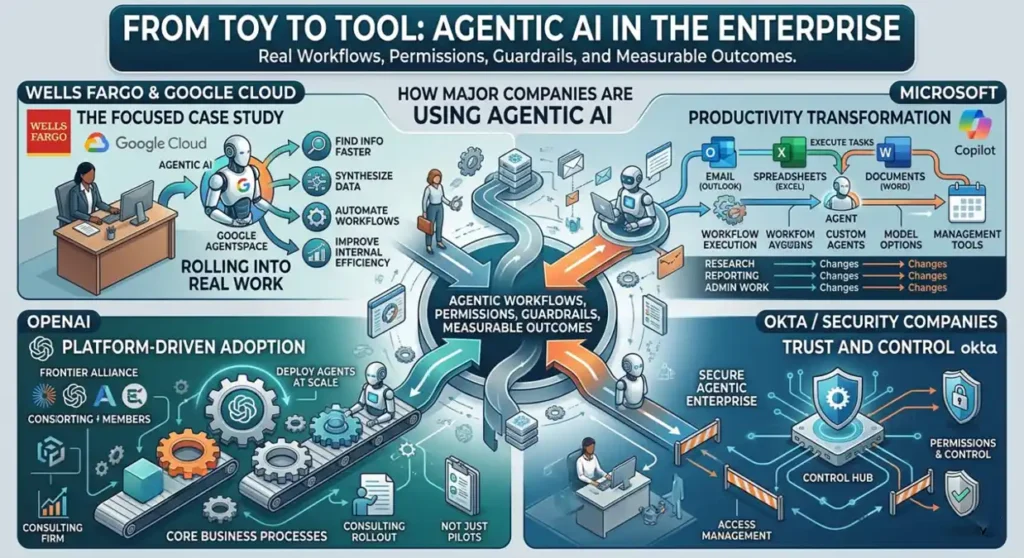
Wells Fargo provides an example of an announced enterprise deployment, rather than a public benchmark of agent performance.
August 5, 2025 — Google Cloud and Wells Fargo announced an expanded relationship around Google Agentspace to help employees find and synthesize information and automate workflows. This is background to the 2026 enterprise-agent story. The announcement does not by itself establish a specific productivity gain or error reduction.
Microsoft is approaching the same trend from the productivity side. Copilot is being pushed beyond drafting and summarizing toward workflow execution, with custom agents, model options, and management tools. The reason this matters is simple: if agents become normal inside email, spreadsheets, documents, and calendars, then the average office workflow changes. Meeting prep changes. Research changes. Reporting changes. Basic admin work changes.
OpenAI Frontier is another enterprise-platform example. Evaluate the access controls, supported integrations and operating model against your use case rather than treating a vendor partnership as evidence that a deployment has already succeeded.
September 22, 2026 — Okta and industry partners announced the Blueprint Alliance, building on the secure agentic enterprise blueprint introduced in March. The shared architecture focuses on discovering agents, controlling permissions, monitoring their actions and responding when something goes wrong. This is a security architecture announcement, not a guarantee that every participating product prevents every agent-related risk.
Now think about what all of these examples have in common.
Nobody is treating agentic AI like a toy. The real discussion is about workflows, permissions, guardrails, and measurable outcomes. That is a much more mature stage than the early chatbot era.
Multi-Agent AI News and New Developments

There is another layer here that gets overlooked.
A multi-agent design assigns separate roles to several agents, such as research, checking and drafting. It can help when the work has clear boundaries, but it also adds coordination, latency and cost. Start with a simpler workflow or one agent unless a measured evaluation shows that additional agents help.
The practical question is whether the extra coordination improves accepted output enough to justify its cost. Compare the same tasks with a single-agent baseline, including failures and human review time.
A simple example makes this easier to see.
Illustrative example: a sales workflow might gather lead information, check the sources and draft an outreach email. Require approval before sending the message or making a consequential CRM change. This is a possible design, not a tested deployment or a promise of higher sales.
Nvidia’s current agentic AI positioning also supports this idea. The company is not just talking about a chatbot with a new label. It is talking about lifecycle tools, inference layers, and deployment systems that support agent workflows in production. In other words, the stack behind the scenes is becoming just as important as the interface in front of the user.
And because of that, infrastructure vendors, identity platforms, and monitoring tools are becoming part of the agentic AI story too.
That part matters more than many articles admit.
Risks and Challenges in Agentic AI Adoption
This is the section too many “AI trend” posts rush through.
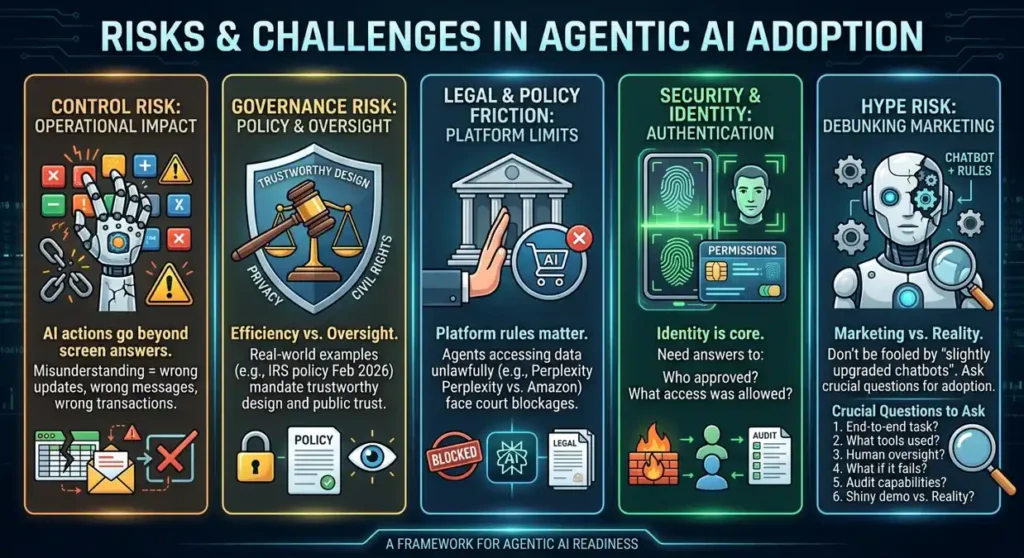
The first big risk is control.
If an AI system has access to email, documents, forms, databases, or browser actions, then a small misunderstanding can turn into a real operational problem. One wrong action is not just a bad answer on a screen. It can become a wrong update, a wrong message, or a wrong transaction.
The second risk is governance.
The IRS Internal Revenue Manual includes an AI governance policy addressing oversight, privacy, civil rights, civil liberties and trustworthy use. It is an example of formal governance requirements, not a certification for commercial AI products. Organizations should check the rules and responsibilities that apply to their own setting.
The third risk is legal and policy friction.
User approval for a task does not automatically grant access to every external platform. Before an agent uses accounts, customer information or third-party services, check the applicable access permissions, service terms and organizational policies. Use supported integrations and escalate unclear permissions instead of assuming that technical access is authorization.
The fourth risk is security and identity.
As agents become more powerful, the question is no longer only “What can they do?” It is also “Who approved that action?” and “What exactly was this agent allowed to access?” That is why identity, permissions, and secure access are becoming core parts of the conversation, not side notes.
The fifth risk is hype.
A lot of products are being marketed as agents right now. Some are impressive. Some are not. In many cases, what is being called “agentic AI” is really just a slightly upgraded chatbot plus automation rules. That does not mean the field is fake. It means buyers need to slow down and ask better questions.
- What task can it complete end to end?
- What tools can it use?
- What human oversight exists?
- What happens when it fails?
- Can the team audit what it did?
Those questions are far more useful than a shiny demo.
What Agentic AI News Means for Businesses
This is where the topic becomes practical.
If you run a business, manage operations, lead marketing, or even work alone, the smartest move is not to chase every new AI product. It is to choose one repeatable workflow and improve that first.
Practical next step: Evaluate AI tools for a business workflow
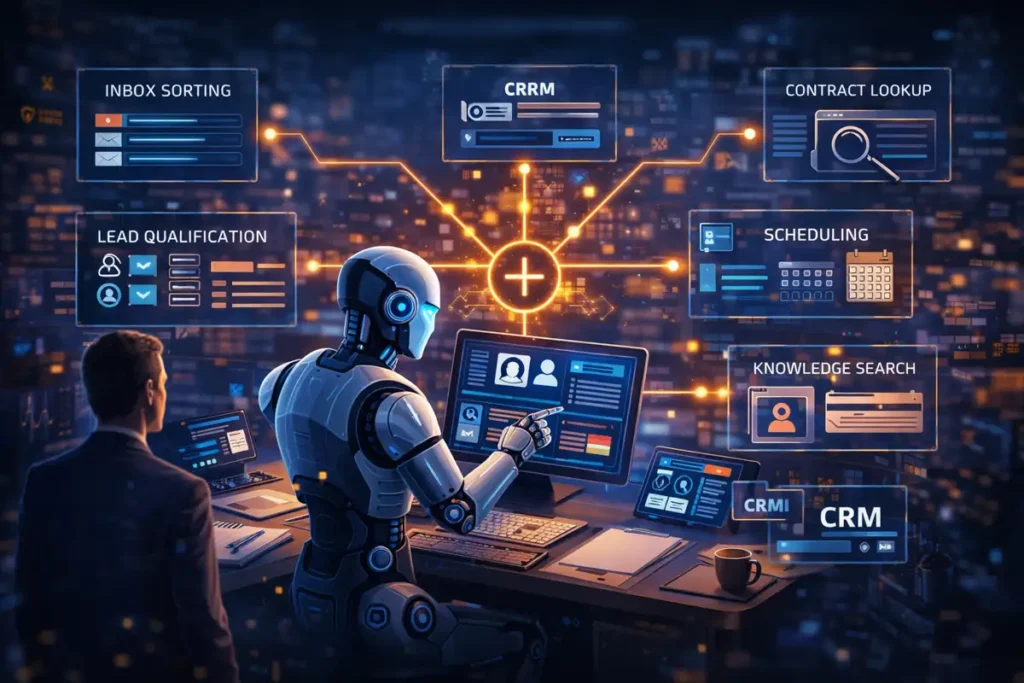
A few good starting points are easy to spot:
- inbox sorting
- lead qualification
- internal knowledge search
- customer support triage
- scheduling and follow-up
- contract or policy lookup
Why these?
Because they are repetitive, structured, and measurable. You can tell if the system saved time. You can tell if the error rate dropped. You can tell if the team stopped doing boring work by hand.
Let’s use a simple example.
Suppose your support inbox gets the same 200 questions every week. A normal chatbot might answer some of them. An agentic workflow can go further: classify the message, pull account data, suggest the answer, draft the response, and escalate the risky cases to a human. That is the kind of use case where businesses begin to see real value.
Another illustrative use is sales research: gather company information, cite sources and prepare a short profile for review. Whether this saves time depends on source quality, the correction work required and the cost of running the workflow.
The key is to start narrow.
Do not begin with “let’s automate everything.”
That is where projects get messy.
Start with one workflow. Set rules. Keep a human in the loop. Measure the results. Then scale.
That approach is boring compared with the hype. But boring is usually what works.
Agentic AI Outlook: Signals and Uncertainties
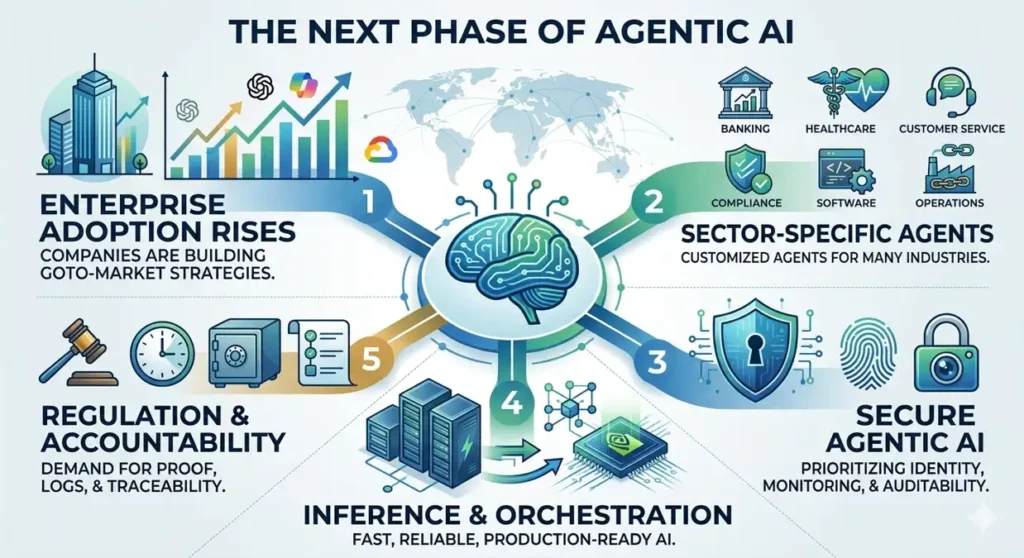
The following are signals to watch, not certain predictions.
Enterprise platforms are investing in agents, but adoption will depend on reliability, integration costs, security reviews and results from controlled pilots. A product launch alone cannot establish how widely it will be used.
Watch for domain-specific workflows with clearly defined permissions and evaluation criteria. Banking, healthcare and customer service have different requirements; a useful demo in one field does not prove readiness in another.
Third, the conversation around secure agentic AI will get louder. Identity, access, monitoring, and auditability are moving closer to the center of the story. The more power agents get, the less optional those controls become.
Inference cost, latency and orchestration remain important evaluation criteria. Track completed tasks and full operating costs, including tool calls and review, rather than choosing a platform solely for a fast model demonstration.
Policy and accountability requirements will vary by jurisdiction and use case. Keep approval records, access scopes and task logs appropriate to the workflow, and review requirements before expanding into sensitive or consequential actions.
Final Thoughts
Here is the simple truth.
Agentic AI news is not just about flashy demos anymore.
The real story is that software is starting to behave less like a passive tool and more like an active worker. In some cases, that will unlock serious productivity. In other cases, it will create new risks around governance, permissions, and accountability. Quite often, both things will be true at the same time.
That is why the smartest response is neither blind excitement nor lazy skepticism.
- Pay attention.
- Test carefully.
- Choose one workflow.
- Keep humans involved where it matters.
- Measure results before you expand.
That is how businesses will separate the useful part of this trend from the noise.
And right now, that difference matters a lot.
Frequently Asked Questions
Is agentic AI the same as a chatbot?
No. A chatbot usually responds to prompts one by one. Agentic AI is designed to pursue goals across multiple steps, often using tools, data sources, and workflow logic along the way.
Why is agentic AI trending in 2026?
Because major companies are moving beyond simple AI assistants toward systems that can handle real workflows. OpenAI, Microsoft, Google Cloud, Nvidia, and security vendors are all pushing products or infrastructure that support this shift.
What are the best business use cases for agentic AI?
Good starting points include inbox sorting, support triage, lead qualification, internal search, scheduling, and other repetitive tasks with clear rules and measurable outcomes.
What is the biggest risk with agentic AI?
Loss of control is the biggest practical risk. If an agent can act across tools and systems, mistakes can have real consequences. Governance, permissions, and monitoring are essential.
Can agentic AI help small businesses too?
Yes, especially in repetitive admin and customer workflows. The best approach is to start small, use clear guardrails, and automate one high-volume task before expanding.
