
In 2026, the robotics industry is no longer a surfeit of technology it’s now in the race for billion-dollar investments. Startups, VCs, and corporates have all jumped into the robotics funding game.
According to recent market data, the global robotics technology market is valued at roughly USD 124 billion in 2026, with projections to reach about USD 416 billion by 2035 at a CAGR of 14.4%. Robotics startups alone have already raised billions of dollars in the first quarter of 2026, showing that this wave is not hype it’s real capital.
This article is a 2026 investor‑style roundup of:
- latest funding rounds and big deals,
- which robotics sectors are grabbing the most money,
- and what all this means for founders, investors, and the broader tech industry.
Why Robotics Funding Is Rising in 2026
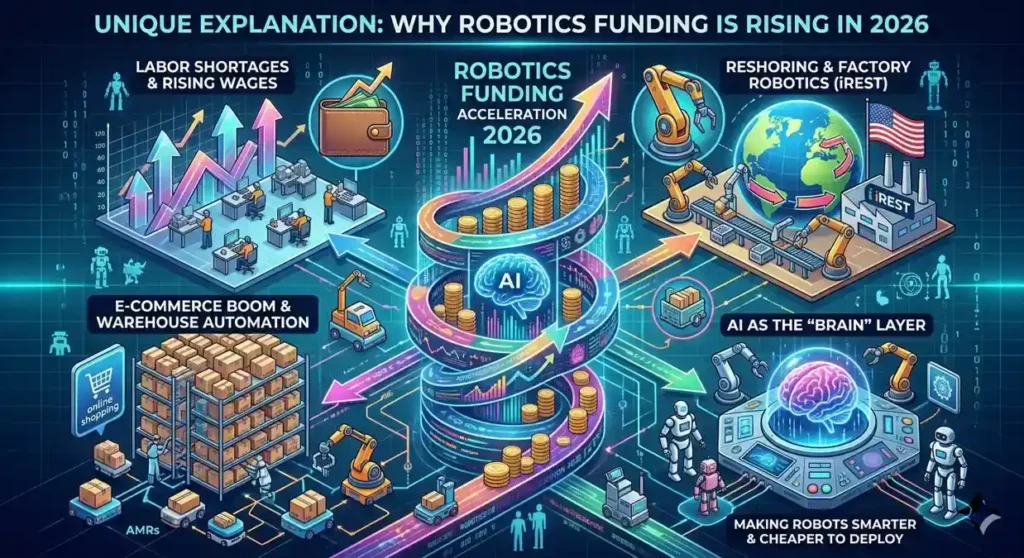
Robotics funding is not just rising — it’s accelerating. In January 2026 alone, robotics startups closed around 110 funding rounds totaling over 4.29 billion USD, which was about five times the dollar amount raised in January 2025. By the end of Q1 2026, the total robotics funding for the year already crossed 2.5 billion USD and climbing, with large‑scale deals in industrial automation, warehouse robotics, and autonomous systems.
The main reasons investors are pouring money into robotics in 2026 include:
- Labor shortages and rising wages in manufacturing and logistics,
- e‑commerce boom pushing warehouse automation and AMRs,
- iREST, reshoring, and near‑shoring trends pushing factory robotics and cobots,
- AI and generative models becoming the “brain” layer for robots, making them smarter and cheaper to deploy.
Latest Robotics Funding News and Big Deals
Below are some of the most notable robotics funding rounds in early 2026, selected to show scale, sector diversity, and investor appetite.
- January 2026: Waabi, a self‑driving trucking startup, raised $750 million in a Series C round, signaling strong confidence in autonomous logistics robotics.
- February 2026: Apptronik, an industrial robotics company, announced $520 million in a Series A extension, focusing on logistics and manufacturing robots.
- March 2026: Mind Robotics raised $500 million in a Series A round led by major tech‑focused VCs, doubling down on factory automation and industrial robots.
- Q1 2026 update: Several other robotics companies, including AI‑driven warehouse and logistics players, closed seed and Series A rounds between $5 million and $50 million, showing that the pipeline from early‑stage to late‑stage is healthy.
These numbers show that robotics funding news today 2026 is not just about one or two “unicorn” stories it’s a sector‑wide capital wave.
Top Robotics Startups Getting Investor Attention in 2026
In 2026, several robotics startups are consistently appearing on investors’ radar, thanks to their rapid innovation and large-scale funding rounds. These companies are not only attracting billions in capital but are also shaping the future of automation, AI, and industrial robotics.
Figure AI – Focused on humanoid robots, Figure AI has secured over $1B in committed capital. The company is backed by major partners like NVIDIA, Salesforce, LG, and Qualcomm, highlighting strong industry confidence in its vision.
Skild AI – Specializing in robotics foundation models, Skild AI raised $1.4B in January 2026, pushing its valuation beyond $14B. This positions it as a key player in building the AI backbone for next-generation robots.
Waabi – An autonomous trucking company, Waabi has raised over $750M in its Series C round. The funding is being used to accelerate commercial deployment and expand its self-driving truck fleet.
Mytra – Known for warehouse automation robots, Mytra is scaling operations in e-commerce fulfillment centers with strong Series C-level funding. Its solutions are helping logistics companies optimize storage and delivery efficiency.
Zipline – A leader in medical drone delivery, Zipline has expanded globally after its Series H funding round. The company is now operating national-scale delivery networks across multiple countries, improving healthcare logistics.
Rhoda AI – Focused on industrial robotics software, Rhoda AI is leveraging its Series A funding to provide manufacturers with AI-driven process automation, increasing productivity and reducing operational costs.
Why These Startups Matter
If you follow AI tools and automation platforms, these robotics startups represent real-world industrial and logistics applications of AI. From humanoid robots to autonomous delivery systems, they demonstrate how artificial intelligence is moving beyond software into physical, scalable solutions.
Robotics Funding News: Top Startups by Recent Capital (2025–2026)
| Startup | Funding | Sector | Stage |
|---|---|---|---|
| Apptronik | $520M | Industrial & Logistics Robotics | Series A |
| Mind Robotics | $500M | Factory / Industrial Automation | Series A |
| Rhoda AI | $450M | Robot Intelligence Software | Series A |
| Mytra Robotics | $120M | Warehouse Automation | Series C |
| OakDeer Robotics | ~$43.5M | Factory + Food & Beverage Robotics | Unknown |
| AI² Robotics | ~$144.7M | AI‑driven Robotics | Series B |
| Anvil Robotics | ~$5.5M | B2B Robotics Software | Seed |
| Flox Intelligence | ~$2.9M | Agri‑robotics Analytics | Seed |
Which Robotics Sectors Are Attracting the Most Capital?
Humanoids
Humanoid robotics is still one of the most hyped segments, but the actual capital is more concentrated than it looks. A 2026 ranking of humanoid robotics startups shows that top 10 players capture about 62% of the total funding in this category, with leaders like Figure AI and UBTECH raising over $1.7–1.8 billion in total funding.
However, because of long development cycles and high hardware costs, many VCs are treating humanoid robots as long‑term option bets, not near‑term revenue machines.
Factory Robotics
Factory and industrial robotics are among the fastest‑growing niches. Collaborative robots (cobots) are projected to grow at a CAGR of around 25%+ through 2031, driven by small and medium‑sized manufacturers adopting automation. Large deals like Apptronik’s $520M and Mind Robotics’ $500M show that investors expect factory robotics to deliver strong returns in 5–7 years.
Warehouse Automation
E‑commerce, same‑day delivery, and labor shortages are pushing warehouse automation to the top of the funding leaderboard. Companies building AMRs (Autonomous Mobile Robots), robotic sortation systems, and warehouse‑robot‑management software are raising hundreds of millions in 2026. For a deeper look at the latest warehouse robotics companies and deployments, see our Warehouse Robotics News page.
Robot Intelligence Software
A new wave of “robot intelligence software” and data‑layer platforms is emerging. Instead of just selling robots, some startups are selling AI models, data pipelines, and simulation tools that help other robotics companies train and deploy robots faster. Rhoda AI’s $450M Series A and similar AI‑focused robotics rounds show that investors view robot‑AI software as the next pick‑and‑shovel layer of the robotics stack.
Why Investors Are Betting on Robotics and AI Automation
Investors are not just “throwing money” at robots they are chasing structural trends:
- Labor‑cost pressure: In many countries, factory and warehouse labor is getting more expensive and harder to hire, forcing companies to automate or die.
- E‑commerce demand: Same‑day and next‑day delivery requires faster, 24/7 warehouses, which is impossible without robot‑powered automation.
- AI maturity: With large‑scale models and simulation tools, robots can now learn faster, generalize better, and require less manual coding, drastically lowering deployment costs.
From an investor’s point of view, robotics is no longer just about “cool robots” This is about software‑driven automation delivering real cost savings and revenue growth. This is why fund‑raises like Apptronik’s $520M and Mind Robotics’ $500M are seen as core portfolio bets, not side experiments.
Risks and Challenges for Robotics Startups
Despite the hype, robotics funding news today is not a free ride. Startups face several structural risks:
- Hardware‑heavy costs: Building and certifying robots is expensive, and failures can wipe out years of runway.
- Integration hell: Factories and warehouses already have legacy systems; integrating robots into them takes engineering time and consulting costs, slowing revenue recognition.
- Regulatory and safety concerns: Especially in human‑facing sectors (like humanoid robots or autonomous vehicles), safety regulations can delay deployment timelines.
- Over‑hype in humanoids: Many investors are worried that humanoid robotics will turn into a “valley of disappointment” where expectations outpace real‑world use cases.
For founders, the message is: focus on clear, repeatable use cases (like warehouse order‑picking, palletizing, or cobot‑assisted assembly) instead of chasing pure “wow demos.”
What Robotics Funding News Means for the Industry
For investors, robotics funding news in 2026 signals that:
- warehouse automation and factory robotics are the safest near‑term bets,
- robot intelligence software is the highest‑growth software layer,
- humanoids are a high‑risk, long‑term option that should only be a small part of a diversified portfolio.
For founders, the takeaway is:
- prove unit economics early (how much money you save per robot),
- focus on verticals with clear pain points (logistics, e‑commerce, manufacturing),
- and build platform‑style capabilities that can be reused across customers, not just custom‑one‑off robots.
For readers of your website, this article on robotics funding news can be a gate‑to‑entry into the broader ecosystem linking to:
- Humanoid Robot News (for humanoid‑specific news),
- Warehouse Robotics News (for deep dives into warehouse automation),
and future guides on AI tools for robotics startups or automation‑startup growth strategies.
Frequently Asked Questions (FAQs)
Q1: What is robotics funding?
Robotics funding refers to the money raised by robotics startups and companies from venture capital firms, corporate investors, and other sources to develop and deploy robots, software platforms, and automation systems. In 2026, this includes everything from industrial robots to AI‑driven warehouse and humanoid systems.
Q2: Why are investors investing in robotics in 2026?
Investors are betting on robotics because of labor shortages, rising automation demand in manufacturing and logistics, and the rapid advancement of AI. The global robotics market is expected to grow from about USD 124 billion in 2026 to roughly USD 416 billion by 2035, making it a high‑growth area for long‑term capital.
Q3: Which robotics sector is growing fastest: humanoids, factory, or warehouse?
Right now, warehouse automation and factory robotics are growing fastest in terms of real‑world deployments and investor follow‑through, while humanoids are more hype‑heavy and long‑term. Data shows that cobots and industrial robots are growing at high double‑digit CAGRs through 2031.
Q4: What are the biggest risks for robotics startups?
Major risks include high hardware costs, complex integration into existing systems, regulatory and safety hurdles, and the danger of over‑promising on humanoid or AI capabilities before revenue proves the market.
Q5: How can investors track robotics funding news?
Investors typically follow specialized newsletters, VC databases, and analytics platforms that track robotics‑specific funding rounds, M&A deals, and market trends. Your article here on Robotics Funding News: Startups, Deals, and Investments in 2026 can also serve as a monthly‑style tracker for your readers.
